
Guide
Wedding welcome sign ideas, sorted by what the board must carry
Wording patterns for a wedding welcome sign, grouped by names and date, direction, and greeting, plus looks that stay readable and where the board should stand.
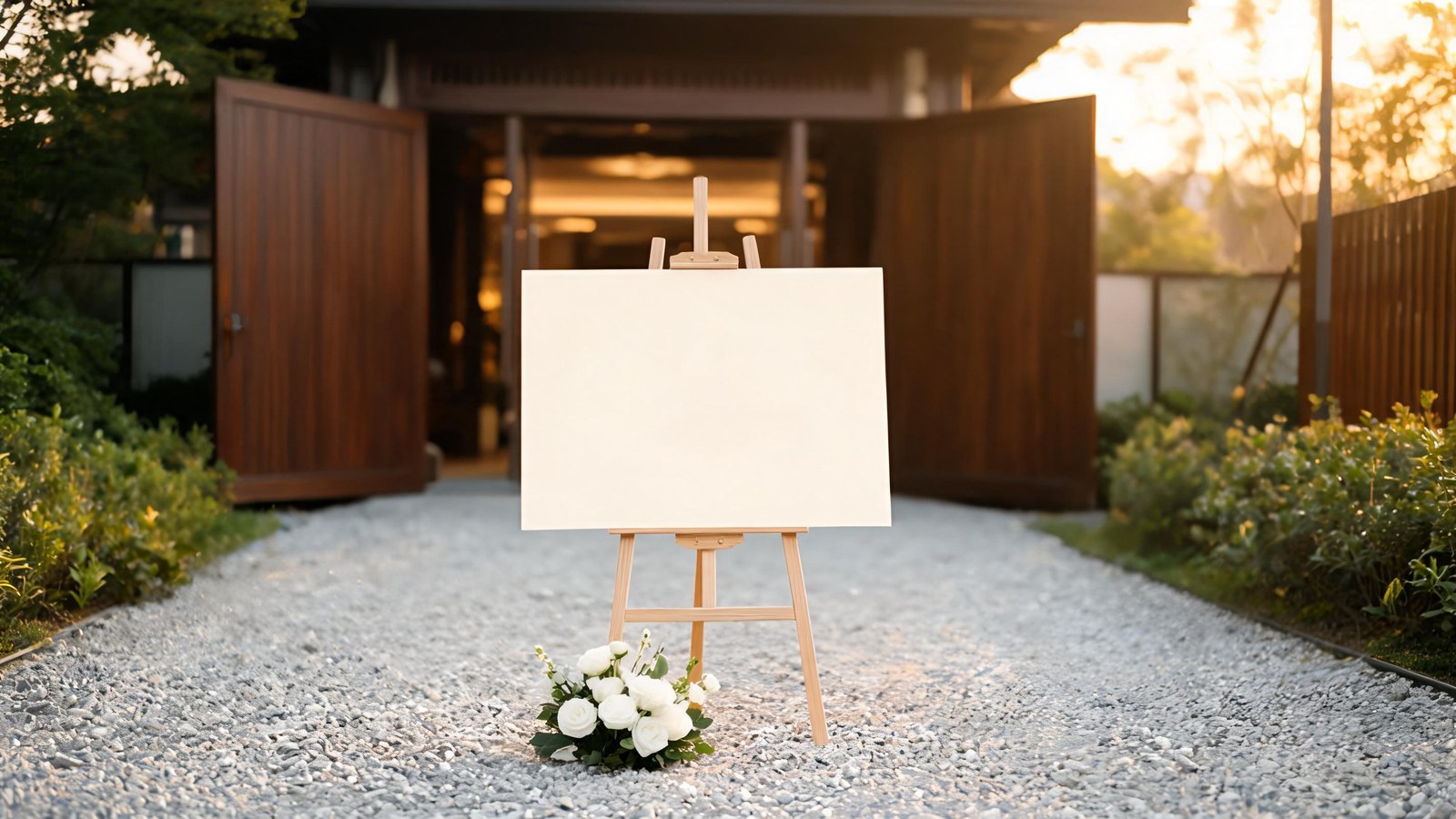
A welcome board works when the words match the job. Carry both names and the date, add a direction if the door is easy to miss, and add a greeting in your own tone. A quote is optional. It should sit under those facts, not instead of them.
What the board carries
The Knot's decor checklist describes the board as names, initials, the wedding date, and an optional greeting, posted near the main ceremony entrance. The Knot treats that board as a way to keep attendees from getting lost ahead of the ceremony. The Garter Girl puts the same job in plainer words: the board tells guests they are in the right place, or points them toward the ceremony, and it is the first design element they see. Emily Post tells a lost-driver story in which a painted board reading "Will and Susan's Wedding" confirmed the right bend in the road.
Those three sources agree on the job and disagree on the shopping. The Garter Girl's gallery is acrylic, wood, mirror, round, and flower-box boards. The Knot's sayings page is a pile of lines. Neither one sorts the lines by what the board has to carry. That sort is below.
Wording by job
Use one line for each job. Guests read the board while walking, so each line should do one thing.
Place. Names plus the date, and the venue if the site is not obvious from the building. "Alex and Jordan, June 14, the river barn" tells a guest they found the wedding. Initials alone are a monogram, not a welcome, unless the names are also there. The Knot includes initials as part of the board, alongside the names and the date, not as a substitute for them.
Direction. Add this only when the path splits. Emily Post groups day-of paper with lines such as "Please Park Here" and "This Way to the Loo." The Knot's sayings roundup has the same job in a lighter voice: "Oh, hi! This way to wedding things," "Shimmy this way!," and "Vows here, party there, love everywhere." Pick one direction line. A stack of jokes does not point anyone to the door.
Greeting. This is the optional line The Knot allows on the welcome board. "It means the world to us that you are here" is on the sayings page, and it does the greeting job. Emily Post asks that the tone match how you speak in person: cheeky can still be elegant, and formal can still be warm. A greeting that sounds like a stranger wrote it is worse than a short "We're glad you're here."
Quote. Love lines belong on a program, a bar board, or a dessert sign more often than on the welcome board. The sayings page includes "All you need is love," song lyrics, and a line from Matthew. Those lines are fine on a second sign. On the welcome board they do not tell a guest the date or the door. If you want one, put it under the names in smaller type.
The Garter Girl's welcome-sign gallery shows acrylic, wood, mirror, and round boards and does not sort wording by what the sign must carry. The Knot's sayings roundup lists sign phrases and does not group them by the job a welcome line has to do. Materials can wait until the lines are chosen. The rest of the day's paper, including table markers and a seating list, is on the decor checklist.
How the board can look
Pick the look after the lines are set. Each pattern below is one line: when it works, and what it needs so a guest can still read the names from the path.
- Minimalist type-only. It works when the site is already busy and the board only has to name the couple and the date, and it needs large names, one ink, and empty space around the date, in the spirit of the minimalist board in The Garter Girl's gallery.
- Arched top. It works at a garden door, and it needs the names set level inside the arch rather than bent along the curve, as on the black and white arched board in The Garter Girl's gallery.
- Framed or botanical. It works when a frame or flowers already sit at the base, and it needs an open center so the frame and the petals do not cover the date.
- Mirror or acrylic look. It works in shade or indoors, and it needs lettering that still reads when the surface catches the sky, which is the test for the mirrored and acrylic boards in The Garter Girl's gallery.
- Rustic wood look. It works at a barn or an outdoor ceremony, and it needs paint or a pressed letter with enough contrast against the grain, which is the job of the rustic wooden board in The Garter Girl's gallery.
- Flower-box. It works when the sign is also the arrangement, and it needs the greeting above the blooms rather than behind them, as on the flower-box board in The Garter Girl's gallery.
- Color-block. It works when two fields split the board, and it needs the names and the date on the same field so the break leaves every word whole, which is how the black and white board in The Garter Girl's gallery keeps the type together.
Where it stands
Post the board at the first moment of doubt. That may be the road, the parking entrance, or the ceremony door. The Knot places it near the main ceremony entrance. The same checklist says a greeting sign can be taken from the ceremony and reused at the reception. Print a second board only if the reception has a different door and a different crowd arriving there.
Stand height matters more than the frame style. A board at knee height disappears behind the person in front of you. An easel, a fence, or a hook at about eye level for a standing guest is the usual fix. Confirm the stand with the venue before you buy a second one. If the site already has a staffed door and a clear name on the building, a board is a courtesy, not a rescue.
Names and order
Either name can lead. Emily Post's formal invitation wording is about the invitation, not the welcome board. On that invitation, if the bride shares her parents' last name, only her first and middle name are used, and the groom's name is spelled out with a title, as in Mr. Stephen Eugene Hall. Hosts' names are spelled out as well. A welcome board is not that invitation. Put both full names on it, in the order you want read first, and skip titles unless you use them everywhere else that day.
Shared surnames, different surnames, and two names that are both long all fit if you give the names their own lines. A monogram under the names is decoration. A monogram instead of the names fails the place job.
A sample board (illustrative)
Priya and Sam host at a farm with two gates. The board on the lane reads:
Priya Shah and Sam Okonkwo September 12 Left gate for parking We're glad you made the drive
The reception door reuses the same board with the direction line covered, because guests already parked. Those names and that date are invented. The four lines are the pattern: place, date, direction, greeting.
Files for the greeting
After the lines are chosen, the board is a printing job, not a furniture job. The Welcome sign includes separate Letter and A4 working welcome signs with generic placeholders to replace. It includes a self-contained offline personaliser, starting and fictional example JSON backups, two generic native SVGs and license notices, and a separate how-to, fictional worked example and actual-product cover in each paper edition, with the actual cover PNG. It includes PDF, HTML, JSON, SVG and a PNG cover. Personal fields on the Welcome sign are two names, date, venue and greeting. Optional poster sizes are 18 × 24 inches and 24 × 36 inches, outlined SVG only, on the Welcome sign, and that outlined SVG export is separate from the Letter and A4 paper editions. It leaves physical printing, mounting and SVG shop acceptance untested.
You still supply the board, the stand, and the printer or the print shop. Ask the shop whether it will take the outlined SVG before you order a large poster. The honest limit of this wording advice is the room: a line that reads well on a phone can vanish on a board at the end of a gravel path. Print one proof and read it from the spot where the first guest will stop.
Questions and answers
What should be on a wedding welcome sign?
Both names, the date, and a short greeting. Add the venue or a direction line if guests could miss the door. A quote is optional and should not be the only line.
What to write on a wedding welcome sign?
Write a place line with your names and date, a direction line if the path splits, and a greeting in your own tone. Keep the names large enough to read from the path.
Whose name goes first on a wedding welcome sign?
Either name can go first. Formal invitation wording is a different piece of paper. Put the name you want guests to read first on the top line.
Where does the wedding welcome sign go?
Place it where a guest first wonders if they are in the right spot: the road, the parking entrance, or the ceremony door. It can move to the reception door later.