
Guide
How to make a DIY wedding welcome sign
Compare a painted board, a foam-board print, and a home-printer sign by tools, cost, and the size you can finish.
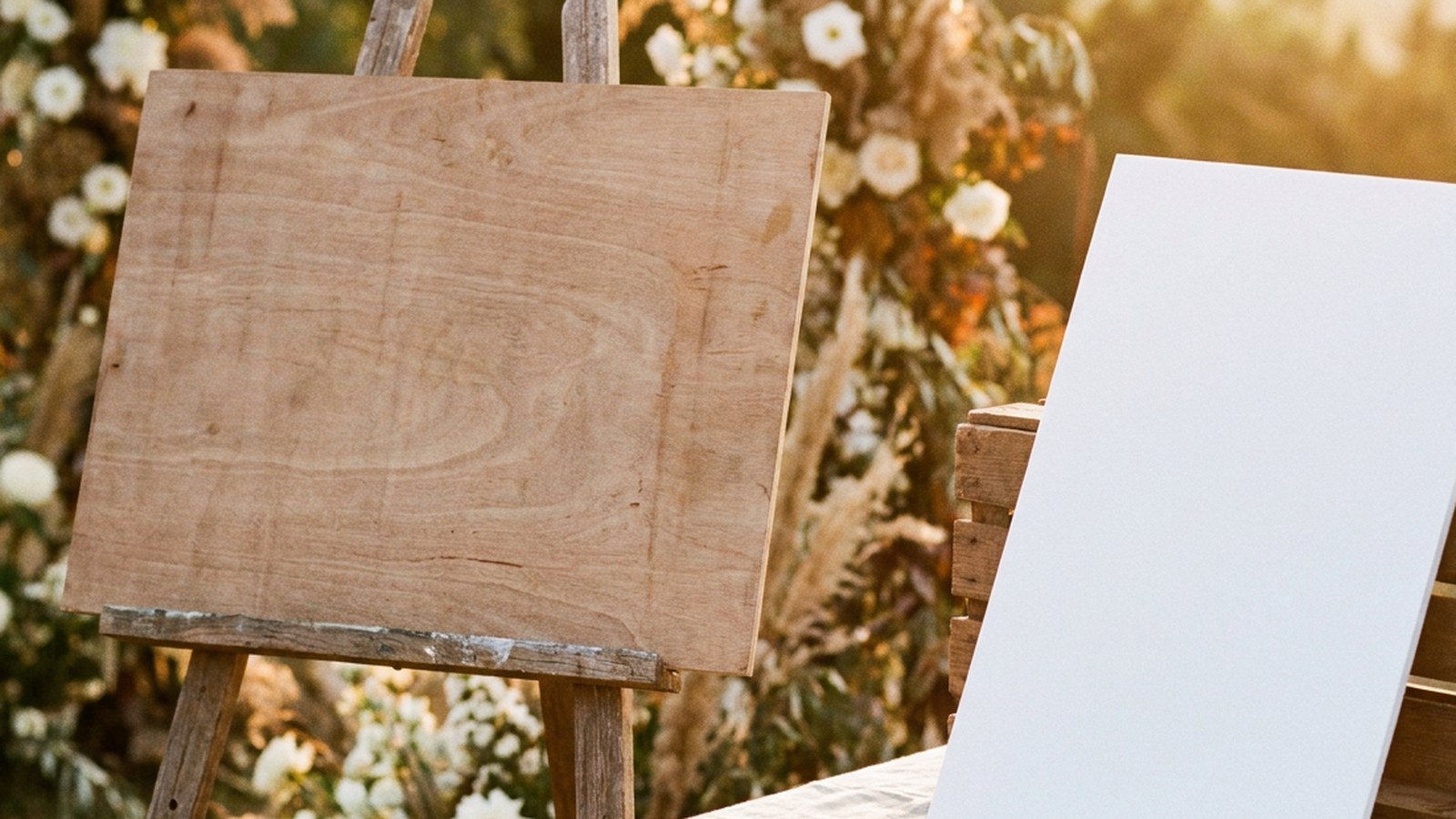
Three paths work when you want to make the welcome sign yourselves. Paint or stencil a board you already have. Order a foam-board print and hang it from a simple stand. Or print a short paper sign at home, and send a larger file to a shop when the entrance needs a poster.
Choose by the tools on hand, what you are willing to spend, and whether guests will read the sign from the door or from a few steps away.
Three ways to make the sign
Paint or stencil a rigid board. A thrifted canvas, a plywood panel, or a foam board you paint yourself needs brushes or a stencil, paint, and a flat surface. This path uses no printer. The finished size is the board you started with. It suits an entrance that can hold a panel, and a couple who would rather mix paint than queue a print.
Print a foam board and hang it. Kayllie Cooper printed a 20×30 foam board for $18 and built a PVC stand from 3/4 inch pipe, spending $12 on a cutter instead of a $50 easel. That is one maker's 2020 receipt, including a coupon on the print. It is not a price you can take to every shop.
Print on paper, at home or at a shop. Bewilderly describes a method to print large designs on a standard A4 printer. The free page is a course pitch. The cut list and the transfer steps sit in the paid lessons, so treat that page as a warning about materials, not as a tutorial you can finish tonight.
A single home sheet is a tabletop card or a small easel sign. A foyer piece that has to be read as people walk in is a shop print or a painted board.
Emily Post treats wedding signs as a way for the couple to speak to their guests, and asks that the tone stay as gracious as you are in person. A joke can still be warm. A direction belongs on the sign only when the entrance is actually confusing.
What the sign should say
Keep the main line to the two names. Put the date or a short greeting under them. Add the venue if guests are arriving somewhere they have not seen. Stop there. A welcome sign that also holds the timeline, the wifi password, and the bar rules becomes a poster nobody finishes at the door.
Short greeting lines are collected in the welcome sign ideas guide. The other paper you may still need is on the wedding decor checklist.
A receipt from one foam-board build
Kayllie's hanging stand is specific enough to copy if you like that look.
She ordered a 20×30 board print, punched holes along the top, and tied the board to a frame of 3/4 inch PVC. Elbows and tees made the corners. She sprayed the pipe and let each coat dry before the next. The print was $18 after a coupon. The cutter was $12. The easel she decided against was $50.
That cost shape is the useful part: the print itself was the small line, and the stand was the piece she built rather than bought. Shop prices and coupons move. A painted board swaps those lines for paint and a panel you may already own. A home print swaps them for paper and ink, and the size stops at one sheet.
When a home printer is the wrong tool
A home printer is a good tool for a sign that lives on a table or a small easel near the guest book. It is a poor tool for the board guests see from the driveway. Taping several sheets together looks like a draft unless you have already practiced the seams. A shop that prints on foam board, or a painted panel, finishes cleaner at that size.
Bewilderly's course exists because couples get stuck on this transfer: pens that bleed, wood that will not take the finish, and a design that will not come out of a home printer at the size they pictured. Budget a practice piece. The first board is the test, not the one beside the door.
A layout you can print
If you want the names, date, venue, and greeting set before you print, the Welcome sign includes separate Letter and A4 working welcome signs with generic placeholders to replace, plus optional outlined SVG at 18 × 24 inches and 24 × 36 inches. It is a digital download for one wedding, and physical printing, mounting and SVG shop acceptance remain untested. It has no oversize PDF, tiled poster, bleed, CMYK or poster PNG export.
Ask the shop whether it accepts outlined SVG before you order a poster. Print one home sheet and read it from the doorway before you commit to a stack.
The honest limit
The method still leaves the board choice to your door. A breezy outdoor entrance wants a heavier panel than a still foyer. Measure the spot, then choose paint, a foam board, or a home sheet. A file, if you use one, only sets the wording.
A porch and a thrifted canvas (illustrative)
Picture a couple with a thrifted canvas already framed, and a covered porch that is calm on an ordinary afternoon. They stencil the names in one color, leave the painting visible around an oval, and hang the canvas on the porch wall. They also print one home sheet as a spare for the guest-book table, in case the porch turns gusty. The canvas is the entrance sign. The sheet is the backup. Those conditions are invented. Your doorway is the measurement that matters.
Questions and answers
How to make a DIY wedding welcome sign?
Paint a board you already have, order a foam-board print and hang it, or print a short paper sign at home. Match the method to the tools you own and to how far guests will stand.
What material should I use for a wedding welcome sign?
Use a rigid board when the sign lives outdoors or in a breeze. Use a foam-board print for a light hanging sign. Use a home-printed sheet only when guests will read it up close.
How can I make a DIY linen wedding welcome sign?
Stretch or frame a plain linen panel and paint or stencil the names. Keep the greeting short so the cloth texture does not swallow the letters.