
Guide
Wedding table number ideas guests can read from the door
Table number ideas judged by whether a guest can read them from the doorway, plus what drives the cost: quantity, material, holders, and printing.
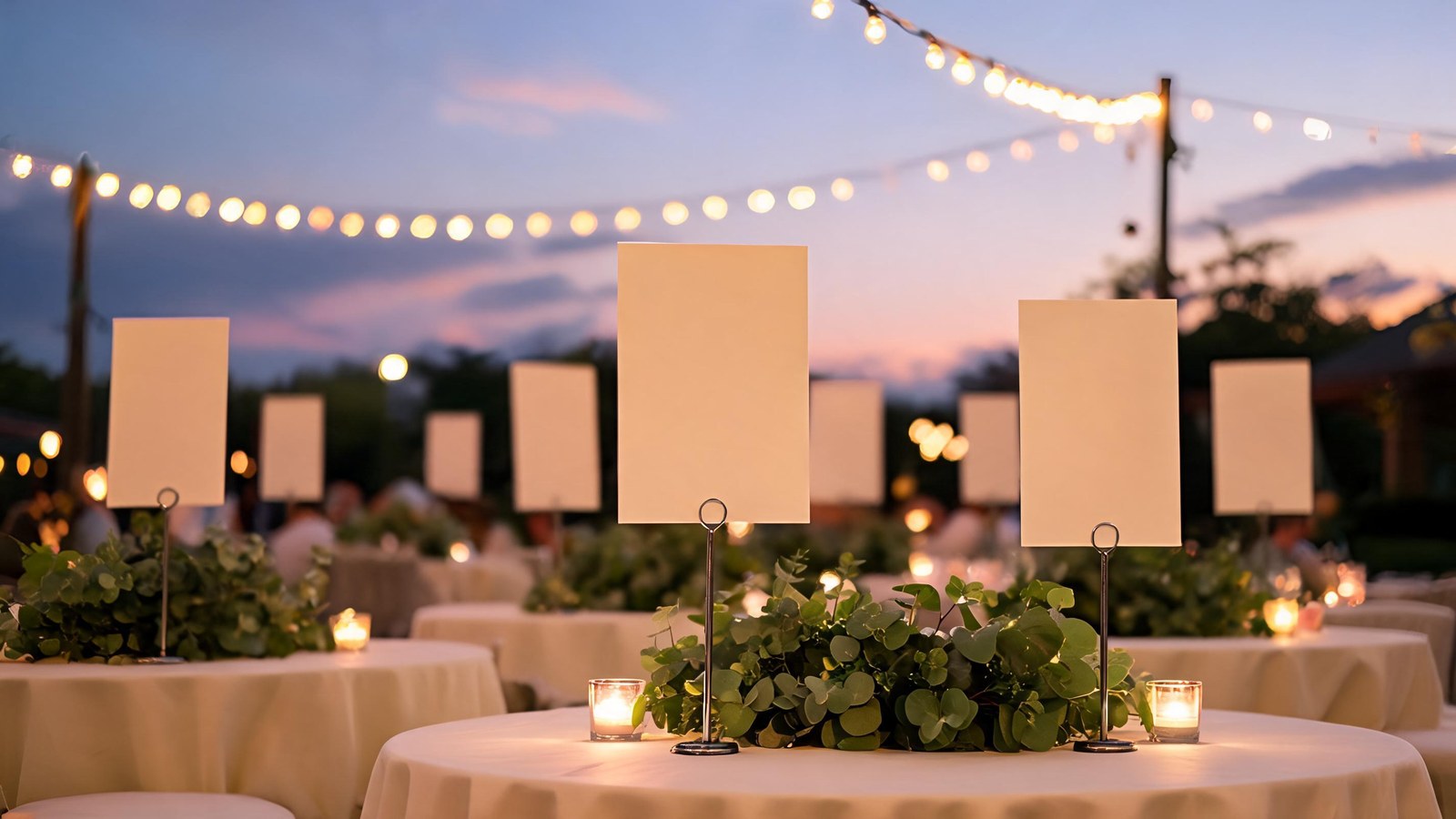
Pick a table marker a guest can read from the doorway, then decide what you will spend. Quantity, material, holders, and whether you print the faces or buy them finished are what move the cost. A tall printed card is the readable default when you already have paper and a stand. A tiny tag on a jar, or a small engraved plaque, fails the doorway test even when it photographs well.
Read it from the door
Paperlust's table-number guide says a 3 x 4 inch card is nearly impossible to spot at a 200-person reception when guests are moving between packed tables in low light. The same guide ties card height to the room: under 80 guests, a 4 x 6 inch card; for 80 to 150 guests, 5 x 7 inches; for 150 or more, at least a 6 x 8 inch card. It also says a card sitting flat between plates is nearly invisible, and that the number needs to sit above the rim of the centerpiece. High contrast does more than a fancy font: black or deep navy on white or cream, or white ink on a dark card.
Budget Savvy Bride makes the same point in shorter form. Keep the marker easy to read, including when the type is a script, and place it where guests can find it rather than under the centerpiece or among the plates. Lily and Lime calls large gilded numbers easy to see, and treats a tag tied to a mason jar as a simple option that can also be the centerpiece. A jar tag is simple. It is not automatically readable from the door. Use the Paperlust heights as the test, then walk the room with one sample before you print the rest. Paperlust sells stationery, so treat the inch guide as that shop's recommendation, not a measurement of your venue.
What you might use, and what changes the cost
Judge each idea by the doorway test first. Cost is not a fixed rank from one style to another. It moves with quantity, material, holders, and printing.
Printed cards on stands. One card per table, cut and set in a wire clip or a small easel. What you spend follows how many cards you print, the paper, and whether you already own a clip or an easel. It passes the doorway test when the card is tall enough for the room, using the heights above. Paperlust also notes that 4 x 6 inches and 5 x 7 inches fit readily available frames if you want a frame later.
Thrift frames with a large numeral. Lily and Lime says mix-and-match frames are easy to gather, especially on the cheap, and that a framed photo of the couple with a number on it personalizes the table. What you spend follows the frames you find and the insert you print, which is a choice of material and quantity rather than a fixed rank. Readability follows the numeral, not the frame. A tiny number in a large ornate frame still fails the doorway test.
Double-duty objects. A wine-bottle label, a tag on a jar of flowers, a slice of wood. Budget Savvy Bride shows bottle labels and wood stands as favorite products. Lily and Lime likes the jar that is also the centerpiece. These save a separate decor purchase. They fail when the number is a small tag hidden in the stems. Put a tall card in the bottle, or raise the wood slice, if you want both jobs.
Bought sculptural sets. Antlers, stone, laser-cut wood, and acrylic stands show up in the Budget Savvy Bride roundup as ready-made sets. What you spend follows how many tables you mark, the material, the holders, and whether the faces are printed or bought finished. A small engraved face can be harder to read across a dim room than a tall card with plain ink. Choose the object when you want that material, then read one sample from the doorway before you order the set.
Budget Savvy Bride's roundup lists favorite products and says to keep them easy to read, and does not sort the ideas by cost and readability. Lily and Lime mentions large numbers that are easy to see and frames on the cheap, and does not sort the set by cost and sightline. The Garter Girl shows unique displays and does not rank them by readability from across the room. The doorway test and the cost drivers above are that missing sort.
Names in place of numbers
A name can replace a numeral if it is just as large. Emily Post calls personalized table cards a lasting trend, most often favorite places, and says any theme can work. Lily and Lime suggests cities, movies, first-date spots, or a historical theme, sometimes with a picture. The Garter Girl separates two jobs that shoppers often merge: a marker on the table, and a way to tell each guest which table is theirs. Names on the tables still need a list at the door. Place cards with the table name, or an alphabetical seating list, do that second job. Emily Post calls place cards a must except at the most casual weddings, and says assigning an actual chair is usually for the most formal ones. Building that alphabetical guest list is covered in how to make a wedding seating chart. Where the marker sits in the wider decor plan is on the decor checklist.
A twelve-table room (illustrative)
A room with twelve tables and about ninety guests sits in Paperlust's middle band, so the sample card is the taller of the two common frame sizes. The couple prints twelve cards, sets them on wire clips above low greenery, and uses city names instead of numerals. The door list is alphabetical. One card is printed the week before and read from the entrance in the evening light they expect. Those guest counts are invented. The order of the test is not.
Cards you can print
When the choice is a flat numbered card, the files can match the two frame sizes Paperlust names for ordinary rooms. The Table numbers are large numbered flat cards that identify already assigned reception tables. They are flat cards only, one per sheet.
You still supply paper, a printer or a print shop, scissors, and holders. The advice above has one honest limit: a seller's inch guide cannot see your lighting. Read one sample from the doorway before you cut the batch. A welcome board for the same entrance is a separate job, covered in welcome sign ideas.
Questions and answers
Do I need table numbers at my wedding?
You need some marker on each table if guests have assigned tables. A name works as well as a numeral. Open seating with no assigned tables can skip markers.
What can I do instead of table numbers at my wedding?
Name the tables after places, songs, or books, and put that name on a card tall enough to read from the door. Guests still need a list that matches each name to a person.
How to display wedding table numbers?
Raise the card above the centerpiece, on a stand or an easel, with dark ink on a light card or the reverse. A card lying flat between plates is easy to miss.