
Guide
Wedding seating chart ideas
Display ideas grouped by how fast a guest can find one name, from a plain alphabetical board to a mirror, escort cards, and keepsakes.
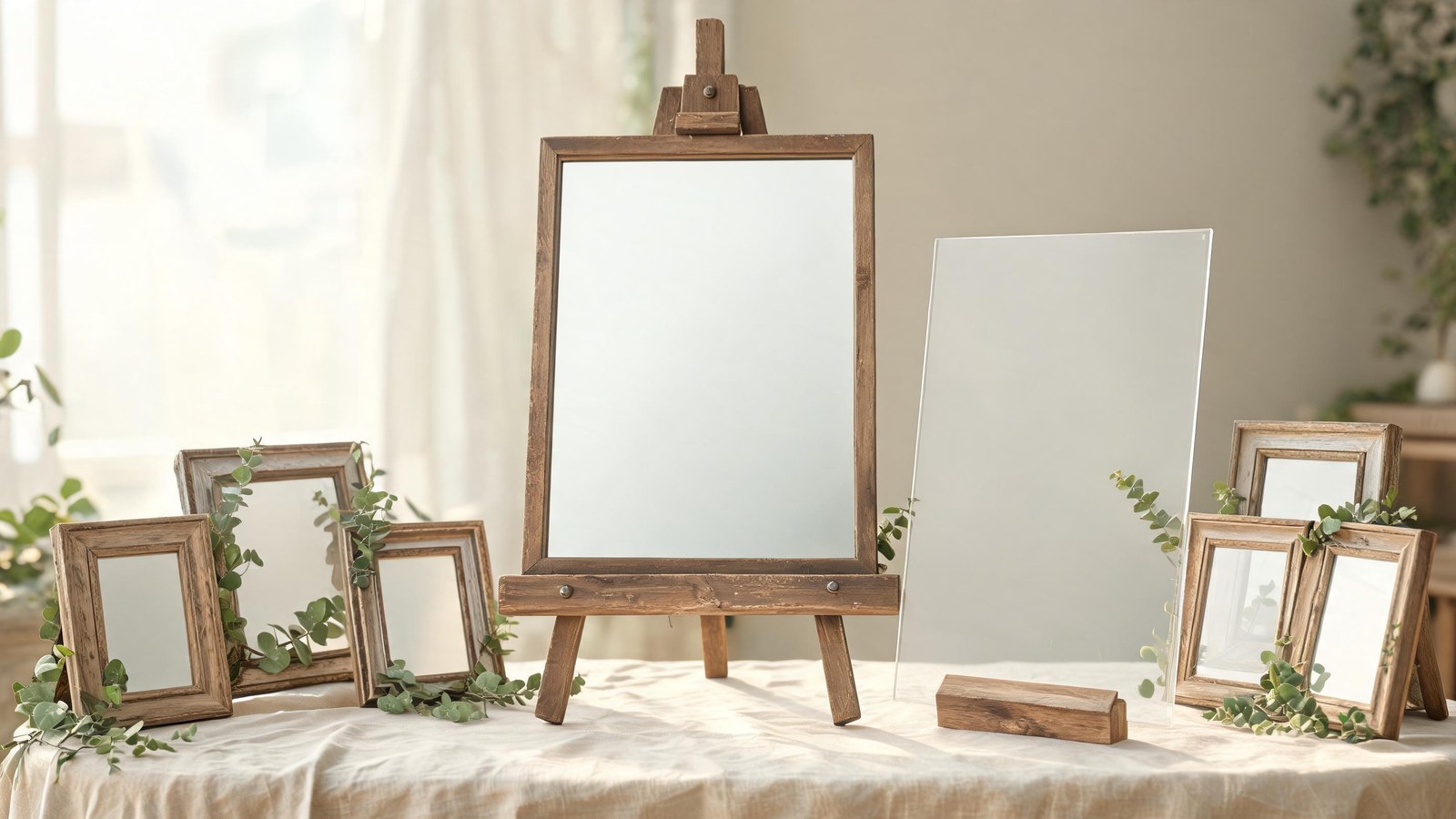
Pick the display by how fast a guest can find one name, not by how pretty the object is. One Fab Day says the table plan has to stay easy to understand, because guests rush it during the drinks reception. These ideas are grouped that way.
Easy to scan while people are queued:
- One poster or board on an easel, names A to Z, table beside each name.
- The same list in two or three printed columns, inside one large frame.
- Escort cards filed A to Z in a box, on a table, or clipped to a line.
- A multi-sheet directory on a stand, still alphabetical, for a long list that will not fit one board in readable type.
Slower, and fine when the list is short or the lettering is large:
- Calligraphy on one mirror, propped on an easel.
- An acrylic panel on a stand, printed or hand-lettered.
- One small frame per table, so a guest scans frames instead of one list.
- A fabric or linen board with a printed list, if the type stays large.
Fun objects that need a plain list beside them once the crowd is big:
- Scratch-off cards that hide the table number.
- Puzzle pieces a guest has to match to a board.
- String art with a color per table.
- A note, envelope, or tag that carries a personal line plus the table.
- A favor, bottle, or leaf that doubles as the table assignment.
- A library-card drawer, luggage tags, or a row of bottles used as the index.
Put whichever you choose where people enter, before they sit. The Knot describes escort cards and seating charts near the reception entrance. The Mansion on Main Street places a mirror at the cocktail-hour or reception door for the same reason: guests pause there anyway.
Read it in a queue
A guest who is holding a drink and blocking the door will not study a design. They will look for their own name. The Knot recommends alphabetical order for large groups, and treats a seating chart as worth making for weddings above 50 or so guests. In that size of room, a single list sorted by last name beats a hunt across every table.
A poster on an easel is the plain version of that list. One Fab Day calls a poster board and a perch one of the easier builds, and asks you to print late so a last reply can still land on the board. Columns help when one column would shrink the type. The test is an arm's length: if you cannot read a surname from where the queue stands, the type is too small, whatever the paper cost.
Escort cards are the same information split into one card per person. The Knot describes them near the entrance, in alphabetical order, each with a name and a table number. They shine when you expect a change the morning of the wedding, because you can rewrite one card. They fail when the cards are pretty and unsorted, because the queue becomes a search.
The assignments have to exist before any of these objects are worth printing. After the tables are set, the Seating chart is a guest-facing sign, not a seating allocator or seat-capacity calculator, and it includes separate Letter and A4 starting directories with 200 numbered guest placeholders. How to get from replies to those assignments is in how to make a wedding seating chart.
Match the words on the display to the table numbers guests will see when they walk in. A welcome board at the same entrance can point people to the chart; ideas for that board are in wedding welcome sign ideas.
Mirrors, frames, and acrylic
A mirror is the idea venues keep photographing. The Hops Company shows a large antique mirror on a vintage easel, a gallery of one mirror per table, and frosted acrylic against a rustic room. The Mansion on Main Street writes names and table numbers directly on the glass in calligraphy. One Fab Day likes a framed mirror and a chalk marker because the writing can be wiped and redone.
Readability is the limit of that look. Calligraphy varies. Glass glares under a window or a spotlight. A gallery of small frames makes a guest check every frame. Use a mirror when the list is short enough that large letters still fit, or hang a printed alphabetical sheet beside the mirror so the glass is the decoration and the sheet is the lookup.
Acrylic has the same rule. A clear panel on an easel looks sharp in a modern room, and One Fab Day notes you can mount it, perch it, or hang it. If the panel is transparent, put a solid wall or a linen behind it, or the names disappear into the room.
When the object is the gift
Some displays are really favors with a table number attached. The Hops Company suggests postcards, luggage tags, a painted timeline, puzzle pieces, scratch-off cards, a moss wall, paper leaves, handwritten notes, a drink paired with the card, and a library-card drawer. One Fab Day adds a hoop with greenery, bottles, plates, string art, and favors that carry the seat.
Those are good hospitality if each guest can take one item and go. They clog the door if every guest must solve a puzzle, scratch a card, or trace a string while twenty people wait. One Fab Day makes that point about string art: use a different color for each table so the search stays short. The same test applies to scratch-offs and puzzles. If the object takes more than a few seconds, post a plain alphabetical board next to it and let the object be a souvenir.
A personal note is the kindest of this group, and the slowest to produce. Write it only for a list you can finish, and file the envelopes A to Z so the note is not also a search.
A short list and a long list (illustrative)
Imagine 36 guests at a dinner in one room. One mirror or one poster holds every name in large letters. A guest finds a surname without stepping closer. A frame-per-table gallery of five frames is still scannable. A puzzle is a toy, not a bottleneck.
Imagine 160 guests walking in from a cocktail tent. The same mirror, lettered small enough to fit, fails the arm's-length test. Two printed columns on a board, or escort cards in a box labeled A to Z, clear the queue. A scratch-off or a string map can sit beside that board for people who want the game after they already know the table.
The counts are invented. The rule is not: time one stranger finding one name. If that takes a conversation, change the display, not the font color.
What a clever display cannot do
A seating chart display publishes table assignments. It does not choose them, and it does not add chairs. If two families need to be apart, that decision happens before you buy the mirror. If the venue path does not pass your easel, move the easel. Beauty at the wrong door is a photograph, not a chart.
Questions and answers
How to display a seating chart for a wedding?
Put an alphabetical name-and-table list where guests enter the reception, on a board, in a frame, or as cards filed A to Z. Add a decorative object only if that list stays easy to scan.
Where does the seating chart go at a wedding?
Near the reception entrance, before guests reach the tables. A mirror or board at the cocktail-hour door works when that is the path people actually walk.
What are some unique ways to display a wedding seating chart?
Mirrors, acrylic panels, one frame per table, escort cards, and small keepsakes such as tags or notes. Unique is fine when a guest can still find one name in a few seconds.