Blog
Wedding Officiant Script: A Full Sample in Order
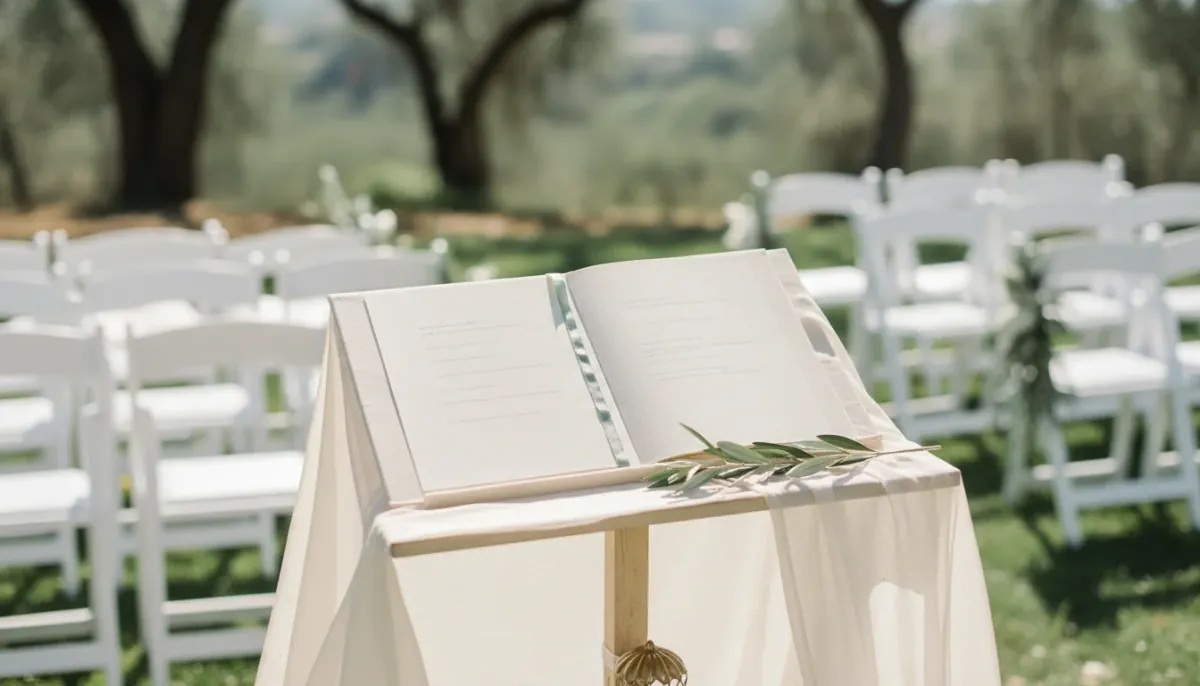
When a friend asks you to officiate, the scariest part is standing up with nothing written down. A wedding officiant script gives you every word in running order, from the processional to the recessional. The full sample below covers the welcome, a reading, the vows, the rings and the pronouncement, and runs about 20 minutes with the music.
A ceremony script has nine parts in a fixed order, and most of the talking happens in the middle. The table gives each part, who speaks, the minutes to allow and the line it becomes on a printed program. The full words follow below.
The wedding officiant script at a glance
| Part | Who speaks | Minutes to allow | Program line |
|---|---|---|---|
| 1. Processional | Nobody, music plays | 3 | Processional |
| 2. Welcome | Officiant | 2 | Welcome |
| 3. The couple's story | Officiant | 3 | Words about the couple |
| 4. Reading | A friend or relative | 3 | Reading, with the reader's name |
| 5. Declaration of intent | Officiant asks, the couple answers | 1 | Declaration of intent |
| 6. Vows | The couple | 3 | Exchange of vows |
| 7. Ring exchange | The couple, prompted by the officiant | 2 | Exchange of rings |
| 8. Pronouncement and kiss | Officiant | 1 | Pronouncement |
| 9. Presentation and recessional | Officiant, then music | 2 | Recessional |
All nine parts add up to about 20 minutes. A second reading, a song or a unity candle adds three to five minutes each. Aim for under half an hour in total, because guests are standing or sitting outside for most of it.
What the law asks of the officiant, state by state
You choose most of the ceremony words yourself, but state law sets the paperwork. Who may officiate, who signs the license and how fast it goes back to the county vary by state. Some rules even vary by county. Three official examples show how far apart the rules sit.
| Place | Who may officiate | Deadline to return the license | Source |
|---|---|---|---|
| California | A clergyperson or another authorized individual | 10 days, to the County Recorder | California Department of Public Health |
| Tennessee | An authorized officiant, who writes the fact and time of the marriage on the license and signs it | 3 days, to the county clerk | University of Tennessee CTAS |
| New York City | Any person 18 or older with a One-Day Marriage Officiant License ($25) | 5 days, to the City Clerk office that issued the license | NYC Office of the City Clerk |
The California Department of Public Health says the officiant who performs the ceremony is required by law to complete the marriage license. The officiant returns it within 10 days for registration. In Tennessee, the county guide from the University of Tennessee's County Technical Assistance Service gives three days. It calls a missed return a misdemeanor that does not invalidate the marriage.
New York City shows how a friend can officiate. The City Clerk's One-Day Marriage Officiant License lets anyone 18 or older solemnize one named couple's marriage. The officiant applies only after the couple has their marriage license, and must make sure everyone signs in the right fields.
Your state may differ from all three. Call the clerk's office that issues your license and ask four things. Can a friend officiate, and what must they file first? Are particular words required in the ceremony? How many witnesses sign? How many days does the officiant have to return the license?
The full wedding officiant script, part by part
Replace the words in square brackets. Read each part aloud once before you change it. A line that is hard to say will be harder on the day.
1. Processional (3 minutes)
Music plays. The wedding party walks in, then the couple, in the order you set at the rehearsal. You stand at the front and say nothing until everyone is in place.
Officiant: Please be seated.
2. Welcome (2 minutes)
Officiant: Good afternoon, everyone, and welcome. My name is [your name], and I'm honored to stand here with [Name 1] and [Name 2] today. You are here because you matter to them. Some of you have known them all their lives. Some of you met them last year. All of you are part of the story that brought them to this moment, and they asked you here to see them make a promise.
3. The couple's story (3 minutes)
Officiant: [Name 1] and [Name 2] met [where and how]. [One short scene: the first date, the moment one of them knew, a habit they share.] When I asked [Name 1] what makes [Name 2] the one, the answer was [their words]. When I asked [Name 2], the answer was [their words].
Three or four sentences are enough. Ask both partners the same question a few weeks ahead, and use their answers word for word.
4. Reading (3 minutes)
Officiant: [Reader's name] will now share a reading.
The reader comes up, reads, and sits down. Give the reader a printed copy in large type. Pick a short poem or passage, and ask the reader to time it at home.
5. Declaration of intent (1 minute)
Officiant: [Name 1], do you take [Name 2] to be your spouse, to love and support, in good times and in hard ones, for as long as you both shall live?
[Name 1]: I do.
Officiant: [Name 2], do you take [Name 1] to be your spouse, to love and support, in good times and in hard ones, for as long as you both shall live?
[Name 2]: I do.
6. Vows (3 minutes)
Officiant: [Name 1] and [Name 2] have written their own vows. [Name 1], please begin.
For traditional vows, the couple repeats after you in short pieces: "I, [Name 1], take you, [Name 2], to be my spouse. To have and to hold from this day forward, for better, for worse, for richer, for poorer, in sickness and in health, to love and to cherish, for as long as we both shall live."
Break long vows into pieces of five to eight words. Nobody can repeat a whole sentence back while nervous.
7. Ring exchange (2 minutes)
Officiant: May I have the rings? A ring is a circle, with no beginning and no end. [Name 1], place the ring on [Name 2]'s finger and repeat after me. "[Name 2], I give you this ring as a sign of my love and my promise."
Repeat for [Name 2]. Agree at the rehearsal who holds the rings, so nobody pats their pockets at the front.
8. Pronouncement and kiss (1 minute)
Officiant: [Name 1] and [Name 2], you have made your promises in front of the people who love you most. By the power vested in me by the State of [state], I now pronounce you married. You may kiss.
Use the "power vested in me" line only once your state allows you to marry the couple. Once the clerk has confirmed you may officiate, the line fits. If you are unsure, say "It is my joy to pronounce you married" instead.
9. Presentation and recessional (2 minutes)
Officiant: Everyone, it is my honor to present, for the first time as a married couple, [the names as the couple wants to be introduced].
Music plays and the couple walks out, then the wedding party. Afterwards, you and the couple, and the witnesses if your state needs them, sign the marriage license. Do it before the photos, while everyone is still in one place. Then return it within your state's deadline.
Turning the script into the order of ceremony on the program
Guests can't see your script, but they can follow the ceremony if they know what comes next. A printed program does that job. Its order of ceremony is your script with the words taken out, one line per part.
A program turns the nine script parts into ten lines. The presentation of the couple and the recessional each get their own line. The order of ceremony that matches this script reads as follows.
- Processional
- Welcome
- Words about the couple
- Reading, [reader's name]
- Declaration of intent
- Exchange of vows
- Exchange of rings
- Pronouncement
- Presentation of the couple
- Recessional
Your program still has room for two more lines if you add a song, a unity candle or a second reading. Put the officiant's name on the program too. Guests often wonder who the person at the front is, especially when it's a friend.
For a program that matches the rest of your wedding paper, our ceremony program templates take exactly this list. In a personalizer, you type the officiant and the order of ceremony (up to 12 lines). You add the wedding party (up to 8 roles), a memory line and a closing line. It opens in Google Chrome on your computer, straight from the downloaded folder, and Download PDF makes the file at the right size. Print at Actual size (100%) on 80 to 110 lb cardstock and cut on the crop marks. Each program is $8 per design. It comes as a flat card at 5 × 7 in or 5.5 × 8.5 in, or as a fan you glue to a stick.
Our program holds the running order only. We don't sell officiant scripts. The words above are free to use and change.
A ceremony feels short to the couple and long to the guests, so every minute you cut is a gift to the people in the chairs.
Delivering the script on the day
Rehearse the whole script once, with a timer, at the rehearsal. You'll find the parts that drag and the names you stumble on. Nerves usually speed you up. If your read-through comes in well under 20 minutes, slow your pace.
Stand slightly to the side during the kiss, so the photographer gets the couple and not you. Ask the couple whether they want a microphone, and test it at the rehearsal if the ceremony is outdoors.
On the day, bring two copies of the script and a pen. Keep the marriage license in the back of the binder, so it's with you when the music stops.
For where the ceremony sits in the whole day, from hair and makeup to the send-off, see the guide to building your wedding timeline. If you'd rather put the order of events on a sign at the entrance, the guide to wedding signs covers what each sign says.
When a printed program is the wrong choice
A program earns its place when there are guests who don't know what comes next. At a courthouse or a backyard ceremony with a dozen people, everyone can see and hear everything, and a program is paper nobody needs.
A long religious service can also outgrow a program card. A full Mass or a ceremony with many readings and rites can run past 12 lines, and our program holds 12. Ask your officiant or your church office for their printed order of service first. If the order has more lines than that, a booklet program from your place of worship fits better than a card.
For most other ceremonies, a short script and a matching card do the job. Our ceremony program in your wedding's design comes in all four of our designs. It is also part of the day-of suite with the menu, signs and table numbers.
Frequently asked questions
What are the 5 parts of the wedding ceremony in order?
Most ceremonies come down to five parts. The processional, the welcome, the vows with the ring exchange, the pronouncement, and the recessional. A reading, a short story about the couple and the "I do" questions fit between the welcome and the vows.
What is the traditional order of the program for a wedding ceremony?
The program follows the ceremony itself. Processional, welcome, reading, declaration of intent, vows, exchange of rings, pronouncement, presentation of the couple and recessional. Add a line for a unity candle, a second reading or a song only if your ceremony has one.
What do officiants use to hold their script?
A plain binder or a stiff folder works best. Print the script in large type, one part per page, so you never lose your place. A binder also keeps your hands steady and looks better in photos than a phone.
Should the officiant walk down the aisle?
Usually not. The officiant takes their place at the front before the music starts, often walking in from the side with the partner who waits at the front, and the wedding party and the couple then come down the aisle.
Conclusion
Write the script in the order guests will live it. Processional, welcome, a short story, a reading, the "I do", the vows, the rings, the pronouncement and the recessional. Give each part a time and keep the whole ceremony near 20 minutes. Before you write a word, call the clerk who issued the license. Ask who may officiate, how many witnesses must sign and how many days you have to return it. Rehearse with a timer and print the script in large type in a plain binder. Then turn the part names into the order of ceremony on your program so guests can follow along.