Blog
Unique Table Numbers: Nine Ideas Guests Can Read
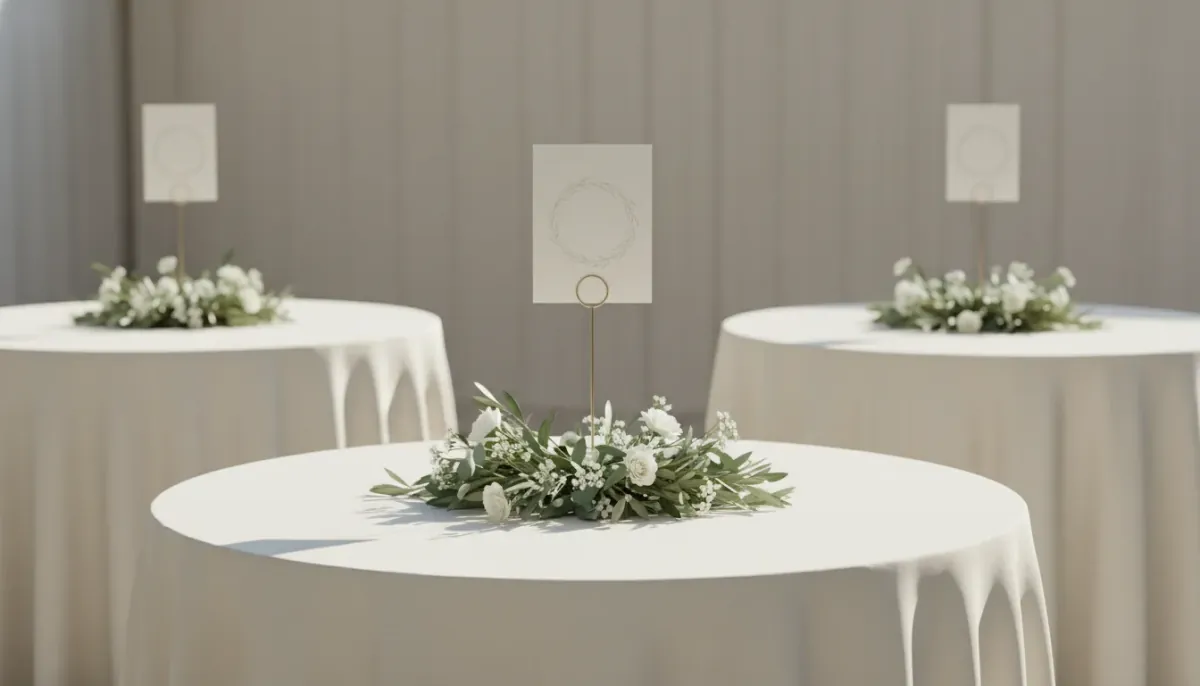
You want table numbers that feel like the two of you, but every guest still has to find a seat without asking for help. Unique table numbers work best when the number itself stays big and clear. The nine ideas below are sorted by how far away a guest can read them, from bold numerals to place names, photos and written-out words.
A table number has one job. A guest holding a drink and an escort card should spot it from a few tables away. Every unique idea below keeps that job and adds something of yours around the number. The further down the list, the closer a guest has to stand to read it, and the more your seating chart and a map at the door have to do.
A table number is a road sign first and a decoration second.
1. Big plain numerals, for a room guests have to cross
A large numeral in dark ink on light paper is the easiest number to read. It's the base for every other idea on this list.
How big is big enough? Sign rules for buildings give a useful yardstick. The U.S. Access Board's guide to the ADA sign standards asks for characters at least 5/8 in tall when the reader stands under 6 feet away. It adds 1/8 in for every foot beyond 6 feet. Those rules are written for wall signs at eye level, and a table card sits lower. Still, they show how fast the needed size grows.
Under the ADA sign rule, a number about 1.75 in tall reads from roughly 15 feet. Few cards that fit on a dinner table carry a number much bigger than that. That's why the seating chart sends guests to the right part of the room, and the number only has to win the last few tables.
2. Gold, black or silver numbers, for contrast that matches your colors
Color is the easiest way to make plain numbers feel like yours. High contrast matters most. A black or deep charcoal number on white or ivory card reads furthest. Gold ink on white looks warm but reads a little less crisply, so give it a larger number.
Printed gold is flat ink with no shine. If you want real metallic gold or silver, you need foil printing, a mirror or acrylic sign, or metal numbers. A home printer can't print foil. Silver is the hardest color to read on paper, because pale gray sits close to white. If silver is your color, put it in the holder or the frame and keep the number dark.
Black table numbers on dark card, with white or gold lettering, look striking in a candlelit room. Check them in the venue's light before you print a full set.
3. A word before the number, for a personal touch
Swap "Table" for a word that says something about you. "Mesa" works for a bilingual family. "No." looks classic. A city you love works too, such as "Lisbon" above the 4. Guests still read the numeral first, so nothing gets harder to find.
Short words read best. A long word set in small capitals over a big number turns into a smudge from across the room. One word, or two short ones, is plenty.
4. "When we were" numbers with a photo, for a story at every table
Each table shows a photo of the two of you at the age on the card. Table 7 gets a picture from when you were seven, table 21 one from when you turned twenty-one. Guests walk over to look, and the photos start conversations.
The card can carry the words "When we were" and the number. The photo goes in a small frame or a clip next to it. Plan the photos first, because a missing age leaves a gap in your numbering. With more tables than photos, skip some ages and keep the numbers in order around the room. Guests find their table by its number.
5. Dog photo table numbers, for couples whose dog is family
Put a photo of your dog, or of every dog in the family, next to each number. Some couples use a different pet photo per table. Others use one favorite picture on every table.
Keep the number on a card of its own. A photo with a number written in a corner gets lost behind the flowers. A clear number card beside the photo frame keeps the joke and the job.
6. Place names instead of numbers, for a small room
Naming tables after places you've lived or traveled is a well-loved idea. The Emily Post Institute's column on printed items calls personalized table cards "a recent trend that seem to be here to stay." The most popular kind names tables after the couple's favorite places.
Names have one weakness. A guest can't guess where "Kyoto" stands. Florida International University's event management procedures say that when tables carry names, or aren't in numerical order, you should put a table map at each entrance. With more than about eight tables, add a small number under the name or keep the map close to the seating chart.
7. Written-out numbers and years, for a formal or vintage look
"Twelve" in flowing script looks elegant on a formal table. Years work as a theme too, such as the year you met or moved in together. Both suit a vintage look with an engraved border or a framed card.
Written-out numbers and years are also the hardest ideas to read. A word like "Seventeen" in script is far wider than "17", so it has to be set smaller to fit the card. A four-digit year needs four digits where a table number needs one or two. Use them in a small room, or set a small numeral underneath.
8. Double-sided numbers, for tables in the middle of the room
A one-sided card faces one way. Guests coming from behind see the back of it. For tables in the middle of the room, use two cards back to back in a two-sided frame, or a stand that holds a card on each face.
Printing a second set costs only paper. Print each number twice, trim both sets, and pair them before you pack the box for the venue.
9. Raised holders, for tall centerpieces
The best number is useless behind a tall vase. The FIU procedures praise low centerpieces "which allows for conversations across the table" and note that the table number was visible. They also warn that table numbers should be in order, because numbers that skip around the room make it "very hard for your guests to find their seats."
If your centerpieces are tall, lift the number. A card stand on a stem, a tall frame on an easel, or a holder clipped to the arrangement all work. If the flowers are low, a frame or a small easel at the front of the table is enough.
How to choose unique table numbers for your reception
Start with the distance the number has to work from. Then add the personal part on top.
| Idea | Reads from across the room | What you need besides the card | Best for |
|---|---|---|---|
| Big plain numerals | Yes, with a number about 1.5 in tall or more | A frame or stand | Any room, any size |
| Gold, black or silver | Yes, if the number stays dark or bold | Foil or acrylic for real metallic | Matching your colors |
| A word before the number | Yes, the numeral leads | Nothing | A personal touch at no cost |
| "When we were" with a photo | Yes, the number stays on the card | One photo per table, a frame or clip | Couples with photo albums to share |
| Dog photo | Yes, with a separate number card | Photo prints and frames | Pet lovers |
| Place names | Only up close | A seating chart and a table map at the door | Small rooms, up to about eight tables |
| Written-out numbers or years | Only up close | Hand lettering or a custom print | Formal or vintage weddings |
| Double-sided | Yes, from both directions | A second print of each number and a two-sided holder | Tables in the middle of the room |
| Raised holders | Yes, above the flowers | Tall stands or easels | Tall centerpieces |
4 × 6 or 5 × 7 in: size by centerpiece
A 4 × 6 in card stands 6 inches tall. A 5 × 7 in card stands 7 inches tall, before any holder. Hold a blank card next to one of your centerpieces before you choose. If the flowers are lower than the card, the smaller size works. If they're taller, go to 5 × 7 and lift it on a stand.
The bigger card also carries a bigger number. The table below gives the height of the printed number on each of the four designs of our printable wedding table numbers, measured on the print files. Using the ADA rule above, it also shows roughly how far each one carries.
| Design | Number on 4 × 6 in | Reads from about | Number on 5 × 7 in | Reads from about |
|---|---|---|---|---|
| Copperplate | 0.6 in | under 6 ft | 0.75 in | 7 ft |
| Olive Grove | 0.8 in | 7 ft | 1.0 in | 9 ft |
| Meridian | 1.3 in | 11 ft | 1.6 in | 14 ft |
| Wild Pampas | 1.6 in | 14 ft | 1.8 in | 15 ft |
What our table number cards can and can't do
Our cards cover ideas 1, 2, 3 and 8 directly. You choose a design and one of six color palettes. Copperplate has an Antique gold palette. Olive Grove, Meridian and Copperplate each have a near-black palette, and in any design you can type your own color as a hex code. You type a word of up to 20 characters before the number, so "When we were" or "Lisbon" fits. The numbers run from 1 to 50, so you set the first and last number and get a full set.
For idea 4, the card gives you the words and the number, and you add the photo in a frame or clip beside it. Ideas 5 to 7 need something else. Our cards print one numeral per card and no photos, so a written-out "Twelve", a four-digit year or a photo printed on the card is a job for a calligrapher or a custom print shop. The gold is printed ink, not foil, the cards print on one side, and the designs are made for white or ivory card, so they don't suit light lettering on dark card.
Where to print table numbers for your wedding
At home, print at Actual size (100%) on cardstock between 80 and 110 lb cover (216 to 300 gsm). Cut on the crop marks with a paper trimmer. Twenty tables at two cards per Letter sheet is 10 sheets. Print one sheet first and stand the card in your holder before you print the rest.
A copy shop is the better choice for very heavy paper or several sets. Take the single-card PDF or the 300 ppi JPG. The guide on how to print wedding invitations covers the printer settings and paper in detail. If you still need to decide who sits where, start with the wedding table seating chart, because the chart and the cards have to match.
Frequently asked questions
Should table numbers be 4x6 or 5x7?
Choose by your centerpieces and your room. A 4 × 6 in card suits low arrangements and small rooms. A 5 × 7 in card stands taller and carries a bigger number, so it suits tall centerpieces and rooms with more than about ten tables. On our cards the number is up to a quarter taller on the 5 × 7 in size than on the 4 × 6 in size.
Are wedding table numbers double-sided?
Ours are printed on one side, and a one-sided card is enough when it faces the entrance. For tables in the middle of the room, print each number twice and set the two cards back to back in a two-sided frame or stand.
What can I do instead of table numbers at my wedding?
Name each table after a place, a song or a book that means something to you. Guests then need a seating chart that lists the names and a small map of the room at the entrance, because a name doesn't tell anyone where the table stands. Many couples keep a small number on the card as well.
How should tables be numbered at a wedding?
In order around the room, so table 4 stands next to tables 3 and 5. Start near your own table with table 1 and work outward. Numbers that jump around the room make guests walk in circles, even with a clear seating chart.
Where to print out table numbers for a wedding?
At home on cardstock between 80 and 110 lb cover, or at a copy shop. A home printer is fine for 20 tables, which is 10 Letter sheets at two cards per sheet. A copy shop is worth it when you want heavier paper or many sets, and it can print from a single-card PDF or a 300 ppi JPG.
Conclusion
Pick the idea by the distance it has to work from. Big numerals in dark ink carry across a room. A word before the number, a gold or black color or a photo beside the card adds the personal part without hiding the number. Place names, written-out numbers and years read only up close, so pair them with a seating chart and a map at the door. Then choose the card size by your centerpieces, raise the card above the flowers, and put the tables in numerical order around the room.