Blog
Wedding Table Seating Chart: How to Seat Every Guest
Seating your guests is the job most couples put off, because one forgotten name or one bad pairing is what people remember. A wedding table seating chart comes together fastest in a fixed order: the final RSVP list, a table count, the tables that are already decided, then families and friend groups, then the gaps, and only then the printed poster.
A seating chart has two jobs. It puts every guest at a table, and it shows guests where that table is when they walk in. You can do the first job on a spreadsheet or on paper in an evening or two. The second job is a poster at the door, made from that same list. Do the steps in order and you only seat each guest once.
Every guest should find their name on the chart before their drink gets warm.
Step 1: Wait for the final RSVP list
Start once your replies are in. A half-finished list means seating some guests twice. The Emily Post Institute's column on handling your guests with grace describes the problem plainly. Until the late replies come in, "You can't work on seating," and the caterer is waiting on you too.
Your reply-by date sets the start. The guide to RSVP wedding cards shows how to work that date back from your caterer's deadline. Call anyone who hasn't answered a few days after it passes.
The institute's wedding planning timeline puts "Finalize the seating plan for the reception" in the final weeks before the wedding. The final head count for the caterer sits in the same weeks. Plan to finish both together.
Step 2: Count your tables
Divide your guest count by the seats per table, then round up. Ask your venue which tables it uses. Round tables are the usual choice. The event setup guide from Colorado State University Pueblo lists 60-inch rounds at 6 to 8 guests per table and 72-inch rounds at 8 to 10.
| Guests | 72-inch rounds, 10 per table | 60-inch rounds, 8 per table |
|---|---|---|
| 60 | 6 tables | 8 tables |
| 100 | 10 tables | 13 tables |
| 120 | 12 tables | 15 tables |
| 150 | 15 tables | 19 tables |
| 200 | 20 tables | 25 tables |
Leave one or two seats open across the room. A guest who brings a surprise plus-one then has a chair, and you don't have to move anyone.
Step 3: Fill the tables that are already decided
You already know who sits at some tables. Fill those first, because every other choice depends on them.
- Your table. A head table with your wedding party, or a sweetheart table for just the two of you.
- Table 1. The table nearest you usually goes to your parents and grandparents. With two families, many couples give each side its own table close by.
- Parents who are apart. If divorced parents don't get along, seat each at their own family table, both near you. Nobody then sits at a "second" table.
- Wedding party partners. If your wedding party sits with you, seat their partners together at a table nearby.
Older guests do best away from the speakers and close to the restrooms. Families with small children like to sit near a door.
Step 4: Seat families and friend groups
Now work through your list by how guests know you. Put college friends together, then work friends, then neighbors, then each side's cousins. Groups that fill one table are easy. Split a big group across two tables that sit side by side.
Solo guests need a little more thought. The Emily Post Institute's advice on seating solo guests is to put them with their peers, even if they haven't met before. It also suggests mixing singles and couples, and keeping couples at the same table, "though not necessarily next to one another."
Step 5: Close the gaps and check every name
Look for tables with one or two empty seats and guests still unplaced. Move one couple instead of five single guests. Then check the list three ways.
- Every guest from the RSVP list appears exactly once.
- Each table adds up to its seats or fewer.
- Every name is spelled the way the guest spells it.
Ask someone who doesn't know your guest list to read the names. Fresh eyes catch the typo you have read past twenty times.
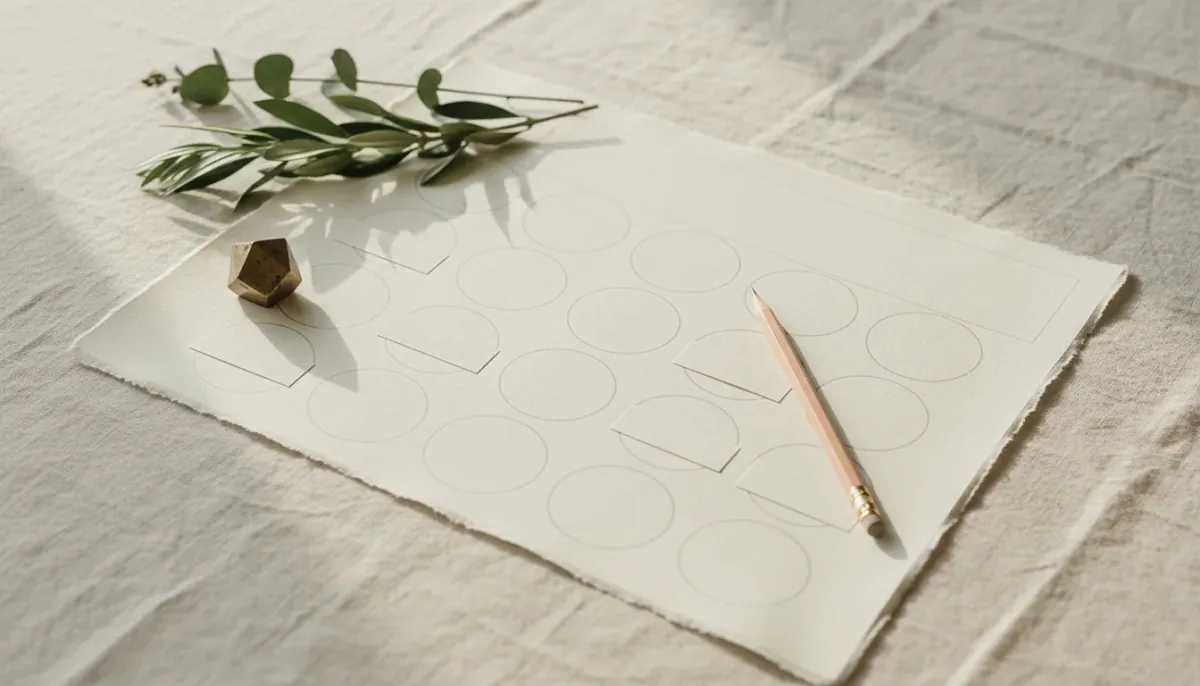
The whole order, from replies to a printed chart, looks like this.
Step 6: Lay out the wedding table seating chart by table or A to Z
A chart by table shows each table as a block, with its guests listed underneath. Guests look for their own name inside the blocks. That's quick when the list is short. With 8 tables of 8, a guest scans 64 names at most.
An alphabetical chart lists every guest once, A to Z, with the table number beside the name. Guests jump to their letter and read one line. Our rule of thumb is simple. Up to about 10 tables, go by table. Past that, go alphabetical, because a by-table chart for 150 guests can make someone read 150 names.
Sort an alphabetical chart by last name. Couples and families who share a name then sit together on the poster. A couple with two last names gets two lines, one under each name.
| Layout | Guests look for | Works best for | Watch out for |
|---|---|---|---|
| By table | Their name inside a table block | Up to about 10 tables | Long lists mean a lot of reading |
| Alphabetical by last name | Their letter, then their line | More than about 10 tables | Guests with two last names need two lines |
Typing 150 names twice is where mistakes creep in. Our wedding seating chart template takes your list of up to 200 guests and their tables, pasted in one go. You choose by table or alphabetical, and add a heading and a second line. The personalizer is a page you open in Google Chrome on your computer, straight from the downloaded folder. It works offline, and nothing is uploaded.
Step 7: Pick the poster size and print it
A seating chart is a poster, so it goes to a print shop. A home printer can't print a sheet this big. The two common sizes are 18 × 24 in and 24 × 36 in. The larger one has twice the area, 864 square inches against 432.
Choose by how full the poster looks. A short list fits 18 × 24 in with room around the names. For a long list, 24 × 36 in keeps the names larger and easier to read. Our seating chart comes in both sizes, so you can check the preview of each before you decide.
At the print shop, ask for foam board if the poster will stand on an easel. Poster paper usually costs less and works in a frame or clipped to a board. Click Download PDF in the personalizer and take the poster PDF to the shop at full size. If the shop asks for an image instead, the personalizer also saves a JPG at 300 ppi. Ask how long they need, and order with a few days to spare for late changes.
Where the poster stands and how it looks are a separate choice. The ideas for the seating chart at your wedding cover easels, frames and other displays. If you'd rather hand each guest a card with their table, escort cards do the same job, and the guide to wedding place cards explains how.
Your seating chart steps at a glance
| Step | What to do | What to watch for |
|---|---|---|
| 1 | Wait for the final RSVP list | Call late repliers a few days after the reply-by date |
| 2 | Count tables from seats per table | Ask your venue which tables it has |
| 3 | Fill your table, table 1 and family tables | Seat parents who are apart at separate tables |
| 4 | Seat families and friend groups | Keep couples at the same table |
| 5 | Close gaps, check every name once | A second reader for spelling |
| 6 | Choose by table or alphabetical | Alphabetical past about 10 tables |
| 7 | Pick 18 × 24 in or 24 × 36 in, print | Foam board for an easel |
When to skip the chart or seat guests another way
You don't need a chart for every wedding. A small or casual reception with a buffet or cocktail food can use open seating. A sign saying guests may sit anywhere does the job. Keep a few reserved seats for grandparents and anyone who needs a chair close by.
Assigned tables matter most at a plated dinner. Servers need to know where each meal goes, and guests who chose a meal expect to get it.
Our seating chart isn't the right fit for every list. It holds up to 200 guests, so a bigger wedding needs a second chart or another format. It's a list of names and tables, not a floor plan you can drag tables around on. If you want the names hand lettered on a mirror or a wooden board, a calligrapher or sign maker is the better choice.
Frequently asked questions
How many tables should you have at a wedding?
Divide your number of guests by the seats at each table and round up. Round tables of 60 inches usually take 6 to 8 guests and 72-inch rounds take 8 to 10, so 120 guests need 12 tables of 10 or 15 tables of 8. Ask your venue which tables it has and how many fit the room.
Should a wedding seating chart be alphabetical or by table?
By table works well for a short list, because guests can scan a few blocks of names. Once you pass about 10 tables, an alphabetical chart with the table number beside each name is quicker, because each guest jumps straight to their letter.
Should a wedding seating chart be alphabetical by first or last name?
By last name. Families and couples who share a name then stand together on the chart, and that is how most guests expect to look themselves up. If a couple has two last names, list each person under their own.
Do you put the wedding party on the seating chart?
Yes, if they sit at the head table or with their partners at a guest table. Everyone with an assigned seat belongs on the chart, so nobody has to ask where they go.
Is it okay to not have a seating chart at my wedding?
Yes, for a small or casual reception with open seating, a buffet or a cocktail-style party. For a plated dinner with meal choices, the caterer needs to know who sits where, so assigned tables and a chart make the night easier.
Conclusion
Start the wedding table seating chart once your replies are in, count your tables from the seats each one holds, and fill the fixed tables before anyone else. Seat families and friend groups next, close the gaps, and check that every name appears once. Then pick by table or alphabetical by how long your list is, choose a poster size that keeps the names easy to read, and send the PDF to a print shop with a few days to spare.