Blog
Wedding Menu Cards: What to Write on Them
Guests with a nut allergy, and everyone who loves food, want to know what's coming before the plates do. Wedding menu cards are worth printing for a plated or family-style dinner, and a good one lists your courses in serving order, with short dish names and clear allergy marks.
Start with your service style. A plated or family-style dinner gets menu cards. A buffet or food stations usually don't, because the food is right in front of your guests. Then list each course in the order it arrives, one plain line per course, and mark the dishes that carry a major allergen. Print one card per guest if you can, or one per table if you're watching the paper count.
A menu card answers the first question every guest asks when they sit down.
| Step | What to do | What to watch for |
|---|---|---|
| 1 | Decide if your dinner needs menu cards | A buffet with labeled dishes can do without |
| 2 | Count cards and paper | One per guest uses ten times the paper of one per table |
| 3 | Write the courses in serving order | Plain dish names beat fancy ones |
| 4 | Mark allergens and dietary choices | Pesto and hummus hide nuts and sesame |
| 5 | Place the card and print it | Wait for the caterer's final menu |
Step 1: Decide if your dinner needs menu cards
The way your caterer serves dinner decides this. At a plated dinner, guests can't see what's coming, so a card tells them. At a family-style dinner, platters arrive in rounds, and a card tells guests how many rounds to save room for.
A buffet is different. Guests walk past every dish and can read a small label beside each one. A menu card at every seat adds little there.
Allergies change the answer. Florida International University's event management procedures say menu cards should always be included so guests are aware of potential food allergies. If you skip seat cards at a buffet, put one printed menu at the start of the line instead.
| Service style | Menu cards? | Usual count |
|---|---|---|
| Plated, with a choice of mains | Yes | One per guest |
| Plated, one set menu | Yes | One per guest or one per two guests |
| Family style | Yes | One per table or one per two guests |
| Buffet | Optional | One card at the start of the line |
| Food stations | Usually no | A label at each station |
Step 2: Count how many wedding menu cards to print
Take a dinner for 120 guests at 12 tables of ten. Printing for every seat means 120 cards. Sharing one between two guests means 60. A single card per table means 12, standing in a holder by the centerpiece.
Paper is where the count bites. A 4 × 9 in menu fits two to a US Letter sheet. So 120 cards take 60 sheets, 60 cards take 30, and 12 cards take 6. On A4 paper only one card fits per sheet, so every count of sheets doubles.
Add spare sheets. Wine gets spilled on a card, a guest's name changes the seating, or the caterer swaps a side dish a week out. Four or five extra sheets cost little and save a second trip to the store.
A card at every seat looks the most finished. One per table is the budget choice and still tells everyone what's for dinner.
Step 3: Write the courses in serving order
List the courses top to bottom in the order the servers bring them. The Emily Post Institute's guide to the formal place setting explains that utensils are laid out by the menu, so guests use them from the outside in. When your card follows the same order, guests can match each fork to its course.
Keep each course to a short title and one line of dishes. Name the food plainly. "Herb-roasted chicken with lemon and spring vegetables" tells guests more than a dish name only the chef understands.
| Line | Example | Tip |
|---|---|---|
| Heading | Dinner | Add your names and the date if you like |
| Course 1 | To start: Heirloom tomatoes, burrata, basil oil, grilled sourdough | One line, main ingredients first |
| Course 2 | Main: Herb-roasted chicken, lemon, spring vegetables | Name the protein first |
| Choice | Or: Wild mushroom risotto with pecorino | Use "Or" for a second main |
| Course 3 | Dessert: Wedding cake and seasonal fruit | Name the cake flavor if you know it |
Six courses is plenty for any wedding dinner. A cocktail hour or a late-night snack can go on the card as its own line if it is served at the tables.
You can type your courses into our wedding menu templates. Each one has a heading and room for up to six courses, each with its own title and dishes. You type them into the personalizer in Google Chrome on your computer, watch the preview and click Download PDF.
Step 4: Mark allergens and dietary choices
Mark any dish a guest might need to avoid. Rutgers Cooperative Extension's bulletin on food allergies lists nine major allergens in the US: milk, egg, fish, crustacean shellfish, tree nuts, peanuts, wheat, soy and sesame.
Some allergens hide in dishes that sound safe. The same Rutgers bulletin names pesto as a possible source of tree nuts, and hummus as a possible source of sesame. A guest with a nut allergy may not think to ask about the pesto on the bread.
Write the marks into the dish line in plain words or short letters. "Wild mushroom risotto (V, GF)" works. So does "Basil pesto (contains pine nuts)". Short letters save room. If you use them, keep them the same on every card.
Don't guess what's in a dish. Ask your caterer for a written list of the ingredients in each course and copy the allergy notes from it. Your caterer knows the sauces and garnishes you never see.
Step 5: Place the 4 × 9 in card on the plate and print it
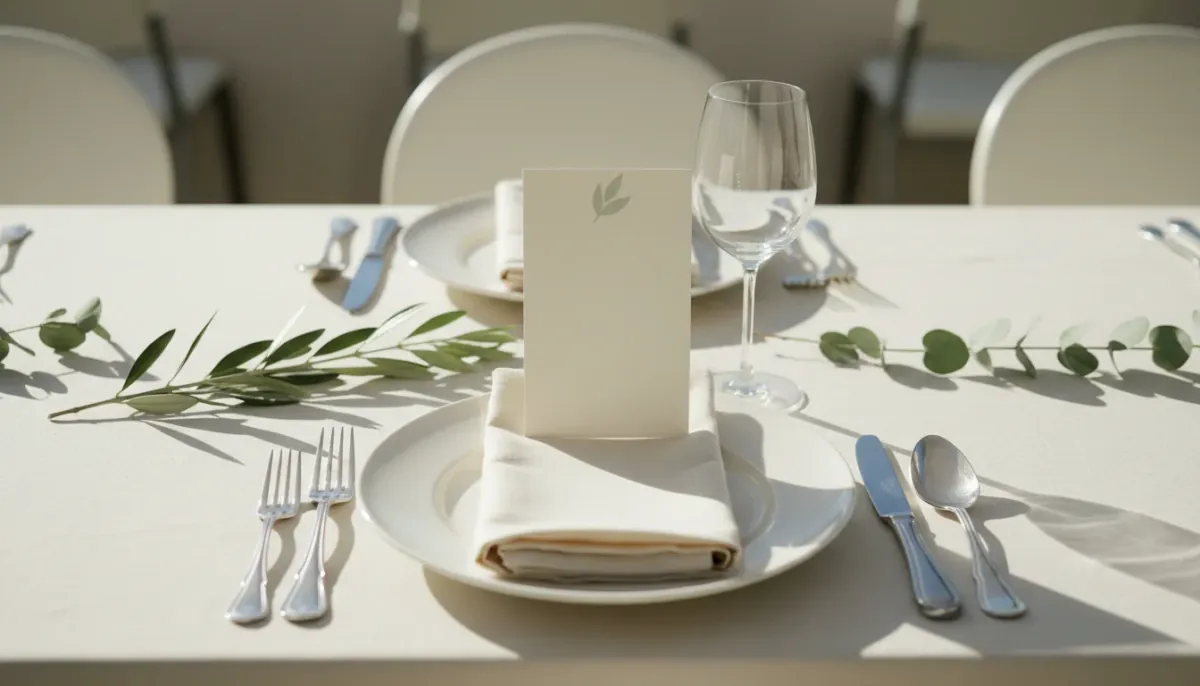
A tall, narrow card suits a place setting. A 4 × 9 in menu stands straight on a folded napkin in the middle of the dinner plate. A place card can sit above the plate, so guests see their name and the dinner at a glance.
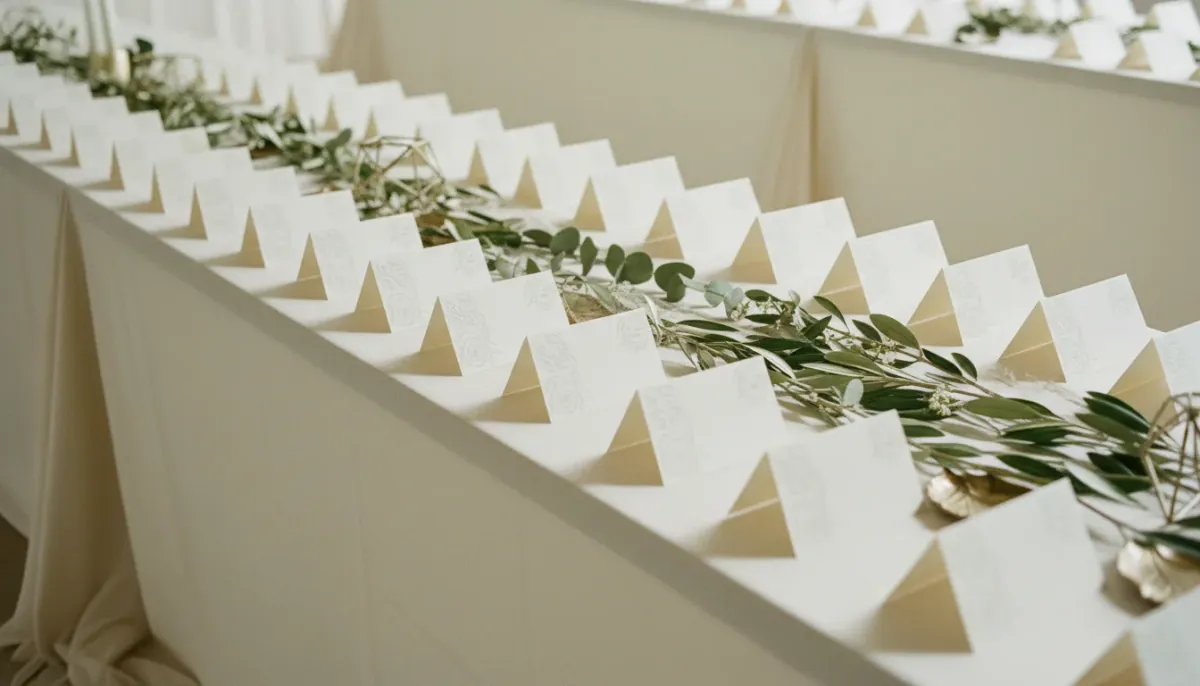
Place cards and escort cards are their own decision. The guide to wedding place cards covers which one you need and what goes on it. Seating guests at tables belongs to the wedding table seating chart.
Print at Actual size (100%), not "Fit to page", so the card comes out at 4 × 9 in. Use cardstock between 80 and 110 lb cover (216 to 300 gsm), so the card stands on the napkin without curling. Cut on the crop marks with a paper trimmer. A trimmer cuts a straighter edge than scissors, and you'll see the edge on a tall card.
When a printed menu card is the wrong choice
A big buffet or a row of food stations can have more dishes than any card holds. Our menu has room for six courses. Twelve buffet dishes with allergy notes won't fit on it, and a small label beside each dish does that job better.
Drinks are a separate piece of paper. A list of cocktails, wine and beer belongs on a bar sign, and the guide to the wedding bar sign covers the wording. Some caterers also print menus as part of their service, so ask before you buy paper.
If you're printing for a plated or family-style dinner, the dinner menu in four designs matches the invitation, place cards and table numbers in the same design. Each download includes a filled example PDF and a blank PDF, so you can see a finished card before you type a word.
Frequently asked questions
What to include on a wedding menu card?
A heading, then each course in the order it is served, with one short line naming the dishes. Mark vegetarian and gluten-free dishes, and any dish that holds a major allergen such as tree nuts or sesame. Your names and the date are a nice touch on top.
What is a good size for a menu?
For a wedding place setting, a tall, narrow card of about 4 × 9 in works well. It sits on a folded napkin on the dinner plate and leaves room for a place card above the plate.
What are common menu design mistakes?
The usual ones are fancy dish names guests can't decode, courses listed out of serving order, missing allergy marks, too many lines for the card, and printing before the caterer has confirmed the final menu.
Conclusion
Print menu cards when guests sit down to a plated or family-style dinner, and skip them for a buffet you can label at the line. Get the final menu from your caterer in writing, list the courses in the order they arrive, keep each dish to one plain line, and mark the dishes that hold nuts, sesame or another major allergen. Then count your cards before you buy paper. One per guest gives the most finished table, one per table costs the least, and a few spare sheets cover the dinner that changes at the last minute.