Blog
Wedding Place Cards vs Escort Cards: Which You Need
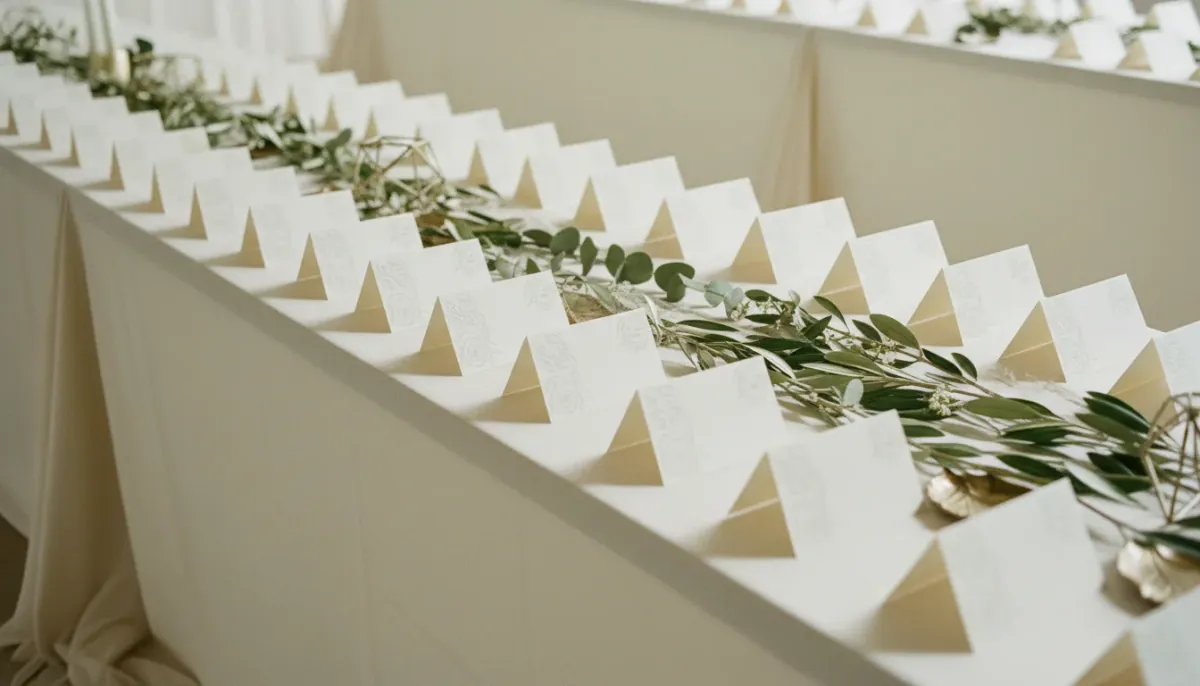
Nobody wants a guest walking the room with a drink in hand, looking for a seat. Wedding place cards sit at each setting and show a guest their exact chair, while escort cards wait near the entrance and tell each guest which table to find.
Place cards mark a seat, and escort cards point to a table. If guests choose their own seats at their table, escort cards alone do the job. If you assign every chair, you need place cards at the settings, plus escort cards or a seating chart to get guests to the right table. A seating chart can replace escort cards. A seat you've assigned still needs its place card.
A guest should find their seat in under a minute, without asking anyone.
Job: wedding place cards vs escort cards
An escort card answers "Which table am I at?" It carries a guest's name and table number. Guests pick theirs up on the way into the reception and carry it to the table.
A place card answers "Which chair is mine?" It carries a name and stands at one setting. Guests only see it once they reach their table.
The Emily Post Institute's guide to printed items for your wedding treats both as one family. It describes place cards "preset at dinner tables or organized on an entry table by name with the table number marked" and calls them a must at all but the most casual weddings. The same guide notes that names may carry titles or not, depending on how formal the wedding is.
You'll need both when you assign seats inside each table. That's common at a plated dinner where servers bring each guest the meal they chose.
Where they sit: place cards vs escort cards
Escort cards go on a table near the door to the reception. Lay them out in alphabetical rows by last name, so guests find their own card fast. Leave room for people to stand around the table without blocking the doorway.
Place cards go on the dinner table, centered above each plate. A tented card stands on its own. A flat card can sit on the napkin or lean against a glass.
The path a guest takes looks like this.
If your tables have names instead of numbers, help guests with a map. Florida International University's event management procedures advise a table layout at each entrance when tables aren't in numerical order or carry names. A small framed plan beside the escort cards does that job.
Wording: place cards vs escort cards
Write each name the way the guest uses it. A formal wedding can use titles, like "Ms. Ana Ruiz". A relaxed one can use first and last names. Keep the style the same on every card.
| What goes on it | Place card | Escort card |
|---|---|---|
| Name | Full name, with or without a title | Full name, often one card per couple or family |
| Table | No, the guest is already there | Yes, "Table 7" or the table's name |
| Meal choice | A small mark for the servers | No |
| Where it reads | Both sides of a tent | One side |
Couples and families can share one escort card, such as "Mr. and Mrs. Lee, Table 4". Every person still gets their own place card at the table.
Spelling matters more than any font. The FIU procedures warn that typos are easy to overlook when you handle every detail yourself, and suggest asking someone to check your work with fresh eyes. The same guide asks you to check how guests with titles like Dr. or Reverend prefer to be addressed.
Handwritten cards are the classic choice. Emily Post's printed-items guide calls them ideal, though printing with handwritten-style fonts is acceptable. Typing a guest list into a template is quicker than lettering every card, and every name comes out the same size.
Format: tented vs flat cards
A tented card is folded in half and stands on its own at the setting. It suits place cards. Print the name on both sides, so guests across the table can read who they're sitting with.
A flat card lies on a table or slips into a small holder. It suits escort cards in rows, and it prints twice as many to a sheet.
Paper adds up fast. Our place and escort cards are 3.5 × 2 in, tented or flat. For 120 guests, tented cards print 6 per US Letter sheet, so you need 20 sheets. Flat cards print 12 per sheet, so 10 sheets do it. On A4 you get 4 tented or 10 flat cards per sheet, which is 30 or 12 sheets.
You don't type 120 cards one by one. You paste your guest list, one guest per line with a name and table, or load it as a CSV file from your spreadsheet. Then you choose name only or name and table, and for tents, the name on one or both sides.
Use cardstock between 80 and 110 lb cover (216 to 300 gsm). Print at Actual size (100%), cut on the crop marks with a paper trimmer, and fold tents on the dashed marks.
Seating chart vs escort cards: when one replaces the other
A seating chart and escort cards do the same job. Both tell guests which table to go to, so you need only one of them. A chart is one poster on an easel. Escort cards are one card per guest or household on a table.
A chart is easier when your guest list changes late, because you reprint one poster instead of rearranging rows. Escort cards are easier to read in a crowd, because guests take their own card and step away. If you go with a chart, the guide to the wedding table seating chart covers how to seat everyone and lay it out.
The FIU procedures add one more option. Their guide gives the president's table assigned name cards even when the other tables have none. At a wedding, that means place cards only at the head table or the family tables, and open seats everywhere else.
Meal choices: place card marks vs a list for servers
If guests chose a main course on their RSVP card, servers need to know who gets what. Advice from the same institute on wording a response card points out that guests may not remember which entrée they chose. It suggests a discreet decoration on the place card that tells servers "beef," "fish" or "vegetarian."
Pick one small mark per meal, such as a colored sticker dot or a sprig stamp. Then give your caterer the key on a single sheet. Our cards print the name, or the name and table, and they have no meal line. Add the marks by hand after printing.
The meal question itself goes on your reply card. The guide to RSVP wedding cards covers the wording.
Summary: place cards vs escort cards
| Dimension | Place cards | Escort cards |
|---|---|---|
| Job | Mark one seat | Point to one table |
| Where they sit | Above the plate | On a table near the door |
| Wording | Name only | Name and table |
| Best format | Tented, name on both sides | Flat, in alphabetical rows |
| Replaced by a seating chart? | No | Yes |
| Meal marks | Yes, for servers | No |
When you can skip them, or print them elsewhere
A small, casual wedding with open seating can skip both. Guests sit where they like, and a sign reading "Find a seat, any seat" says so.
Our cards aren't the right buy if you want true hand calligraphy, a printed meal icon on each card, or names in a script outside the Latin alphabet such as Greek or Cyrillic. A calligrapher or a custom print shop handles those.
If you're printing from your own guest list, the place and escort cards in four designs match your menu, table numbers and seating chart. Each download includes a filled example PDF and a blank PDF you can hand-letter if you'd rather write the names yourself.
Frequently asked questions
What is a wedding escort card?
A small card with a guest's name and table number. Escort cards are set out near the entrance to the reception, usually in alphabetical rows, so each guest picks up their card and finds their table.
What is the difference between seating cards and place cards?
A seating card, also called an escort card, tells a guest which table to go to. A place card sits on the table and marks the guest's exact seat. Escort cards wait near the door, and place cards wait at the setting.
What to write on wedding place cards?
The guest's full name as they use it, with or without a title depending on how formal your wedding is. Escort cards add the table number. On tented cards, print the name on both sides so the guests across the table can read it too.
What size should wedding place cards be?
There is no fixed rule. A card has to hold a full name in letters a guest can read from their chair. Our cards are 3.5 × 2 in, either folded into a tent that stands on its own or flat.
What paper is best for place cards?
Cardstock between 80 and 110 lb cover (216 to 300 gsm). Lighter paper may sag as a tent, and heavier stock may not feed through a home printer.
Conclusion
Escort cards send each guest to a table, and place cards put them in a chair. Most weddings need one of the two, and a plated dinner with meal choices usually needs place cards at the seats. Write full names the way your guests use them, check the spelling with fresh eyes, and add the table number to escort cards. If you already have a seating chart, it does the escort card's job, so you can skip those and print place cards only where seats are assigned.