Blog
Wedding Welcome Sign Size: Pick It by Distance
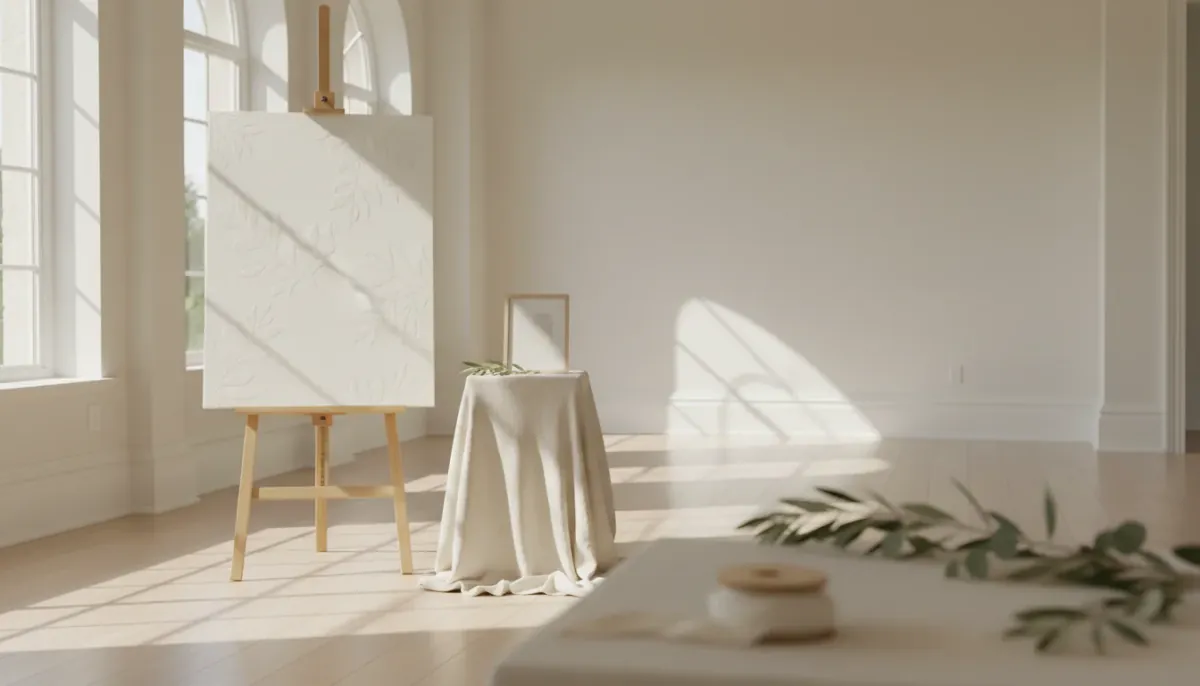
You only find out on the day whether guests can read your welcome sign from the door, when it's too late to reprint. The right wedding welcome sign size depends on how far away guests first read it. Use 8 × 10 in for a table they walk up to and 18 × 24 in for an indoor easel by the door. An outdoor entrance or a long walk needs 24 × 36 in.
A wedding welcome sign has one job: guests read your names and know they've found the right wedding. Size decides whether that works. Measure where guests will stand when they first look at it, then use the table below.
| Size | Where it works | Read from | Print on | Where to print |
|---|---|---|---|---|
| 8 × 10 in | A table at the entrance or guest book | Up to about 6 feet | Cardstock in a frame | Home printer |
| Full Letter or A4 sheet | A small easel on a table | Up to about 6 feet | Cardstock in a frame | Home printer |
| 18 × 24 in | An indoor easel by the door | About 10 feet | Poster paper on foam board | Print shop |
| 24 × 36 in | An outdoor entrance, a long hall, a hanging sign | About 15 feet or more | Poster paper on foam board | Print shop |
The steps below show where those distances come from, and how to check your own sign before you order.
Step 1: Measure how far away guests read the welcome sign
Stand where guests will first look for the sign. That might be the parking lot, the hotel corridor or the top of the garden path. Measure the distance to where the easel or hook will be. This is your reading distance.
The federal accessibility standard for building signs gives a useful yardstick. The 2010 ADA Standards for Accessible Design measure viewing distance horizontally. It runs from the letters to the point where a person can't get any closer. For signs whose text sits 40 to 70 inches off the floor, capitals must be at least 5/8 in tall under 6 feet. Each extra foot of distance adds 1/8 in.
Worked out for a welcome sign, the rule gives these minimums for the smallest line guests need to read, usually the date or the venue.
| Reading distance | Smallest capitals | Sign that usually fits |
|---|---|---|
| Under 6 feet | 5/8 in | 8 × 10 in or a full sheet on a table |
| 10 feet | 1 1/8 in | 18 × 24 in |
| 15 feet | 1 3/4 in | 24 × 36 in |
| 20 feet | 2 3/8 in | 24 × 36 in with large type |
| 25 feet | 3 in | Larger than 24 × 36 in, or move the sign closer |
Your names are much bigger than the date, so they'll read from farther away. Size the sign for the smallest line you care about. A guest who reads "Ana & Luis" but not the venue can still walk into the wrong room.
Step 2: Match the wedding welcome sign size to that distance
Bigger paper only helps if the letters grow with it. When a design is enlarged from 8 × 10 in to 18 × 24 in, the width limits how far it can grow. Everything gets about 2 1/4 times bigger. Enlarged to 24 × 36 in, it gets about 3 times bigger.
Say the date line on an 8 × 10 in version has capitals 5/8 in tall. At 18 × 24 in, they're about 1 3/8 in, enough for about 12 feet. At 24 × 36 in, they're about 1 7/8 in, enough for about 16 feet. Your names are set larger than the date, so they carry farther still.
You don't need to guess. Print the sign on a Letter or A4 sheet and measure the capital letters of the date line with a ruler. Multiply by 2 1/4 for 18 × 24 in or by 3 for 24 × 36 in. Compare the result with the table in step 1.
A 16 × 20 in sign sits between the table and easel sizes. Enlarged from 8 × 10 in, the text only doubles, so it suits a table sign or a bar sign more than an entrance. Larger than 24 × 36 in is rarely needed. If your guests first see the sign from 25 feet, moving it closer usually works better than a bigger board.
Step 3: Decide whether it stands on an easel, sits on a table or hangs
Where the sign goes changes what it needs. Check this before you order, because a poster that fits the distance can still fail on the wrong stand.
On a floor easel, the sign needs to be rigid. A sheet of poster paper alone curls and slides off the ledge. Measure the easel's ledge and the top clamp. An 18 × 24 in board needs the clamp to open to at least 24 inches. A 24 × 36 in board needs 36 inches in portrait.
On a table, an 8 × 10 in sign goes in a standard photo frame. A full Letter or A4 sheet fits a small tabletop easel. Both are close-up signs, so put them where guests stop, such as the guest book or the gift table.
A hanging wedding welcome sign, from an arch, a door or a wall, needs to be light. Foam board with two holes and a ribbon is the usual way. The ADA standard sets a floor of 40 inches for the bottom of visual characters on building signs. That's a sensible minimum here too, so flowers, chairs and other guests don't hide the lowest line. Hang the names near eye level.
Step 4: Choose what to print the welcome sign on
The paper decides how the sign looks in daylight. At home, print the 8 × 10 in sign or the full sheet at Actual size (100%). Use cardstock, 80 to 110 lb cover (216 to 300 gsm). Frame it, or stand it on a small easel.
At a print shop, a poster is printed on poster paper. Ask for it to be mounted on foam board if it will stand on an easel or hang. Foam board keeps it flat and light enough to move between the ceremony and the reception.
Choose a matte finish over glossy. The ADA standard asks for a non-glare finish on signs, and that matters outdoors. A glossy poster in afternoon sun reflects the sky, and guests see a white patch where your names should be.
Ask the shop for a price before you order, because poster size, paper and mounting each change the cost. Prices vary a lot between shops, so ask for two quotes with the same size, paper and mounting.
Step 5: Give the print shop a file made at the final size
The file you send matters as much as the size you order. A small image stretched to poster size prints blurry, however good it looked on screen.
The Winchester Public Library's poster printing page is a clear example of what a print counter asks for. It prints 18 × 24 in (Arch C) at 240 DPI recommended and 200 minimum. For 24 × 36 in (Arch D) it recommends 200 DPI, with 150 as the minimum. It prefers PDF and says files must meet the pixel requirements at the final print size. It also warns that increasing the DPI of a small image won't improve print quality.
Never enlarge an 8 × 10 in file to make a poster. Ask for a PDF made at 18 × 24 in or 24 × 36 in from the start. Tell the shop to print at 100% with no scaling, on matte paper, mounted on foam board if you need it.
Our wedding welcome sign is built for this step. It comes with 18 × 24 in and 24 × 36 in poster PDFs for a print shop. For home printing, you get an 8 × 10 in sign and a full Letter or A4 sheet. The personalizer also saves a JPG at 300 ppi for shops that take images.
| Step | What to do | What to watch for |
|---|---|---|
| 1. Measure | Measure from where guests first look to where the sign stands | Use the farthest point, not the door itself |
| 2. Match the size | 8 × 10 in up close, 18 × 24 in for about 10 feet, 24 × 36 in for 15 feet or more | Size for the date or venue line, not the names |
| 3. Place it | Easel, table or hanging | Easel clamp opening, hanging weight, 40 in minimum height |
| 4. Choose the material | Cardstock at home, poster paper on foam board at a shop | Matte, not glossy, for outdoor light |
| 5. Send the file | A PDF made at the final size, printed at 100% | Never enlarge a small file |
A welcome sign is the right size when a guest can read the date from where they first look for it.
When a printed poster is the wrong choice
Our welcome sign comes in four sizes: 8 × 10 in, a full Letter or A4 sheet, 18 × 24 in and 24 × 36 in. If you need a different size, such as 16 × 20 in or a large banner, it's the wrong file. A wooden, acrylic or mirror sign needs a sign maker, so our file is the wrong choice there too. For the wording itself, see wedding welcome sign ideas. If the seating chart will stand on an easel next to it, ideas for a seating chart at a wedding covers displays.
For a standard easel at the entrance, the printable welcome sign in four sizes costs $8 per design, in four designs. After you pay, a download link arrives by email. You open the personalizer from the downloaded folder in Google Chrome on your computer, type your names, date and venue, and click Download PDF. You print the small sizes at home and take the poster PDF to a print shop. The files are for your own wedding only.
Frequently asked questions
What is the standard size for a wedding welcome sign?
There's no official standard. Pick by distance. A sign on a table that guests walk up to can be 8 × 10 in. An easel by an indoor door works at 18 × 24 in, and an outdoor entrance or a sign read from 15 feet or more needs 24 × 36 in.
Is 18x24 big enough for a wedding welcome sign?
Yes, for an indoor entrance where guests read it from about 10 feet or closer. For an outdoor path, a parking lot or a big room where guests first see it from 15 to 20 feet, choose 24 × 36 in.
Is 16x20 big enough for a wedding sign?
It works for a sign guests read from a few steps away, such as a guest book or bar sign. For a welcome sign at the entrance, 16 × 20 in is on the small side. Text enlarged from 8 × 10 in to 16 × 20 in only doubles in height, so the date and venue lines may be too small from 10 feet.
Where to hang a welcome sign?
Hang it where guests first wonder if they're in the right place, such as the front door, the ceremony entrance or the end of the path from the parking lot. Hang it so the lowest line of text is at least 40 inches off the ground and the names are near eye level.
Conclusion
Measure where guests will first read your welcome sign, then size it so the smallest line is tall enough for that distance. That usually means 18 × 24 in on an indoor easel and 24 × 36 in outdoors or at a long entrance. Keep 8 × 10 in for tables. Mount any poster on foam board if it stands on an easel or hangs, and choose a matte finish. Give the print shop a file made at the final size. A test print at home and a tape measure answer the question better than any size chart.