Blog
Wedding Details Card: What to Include
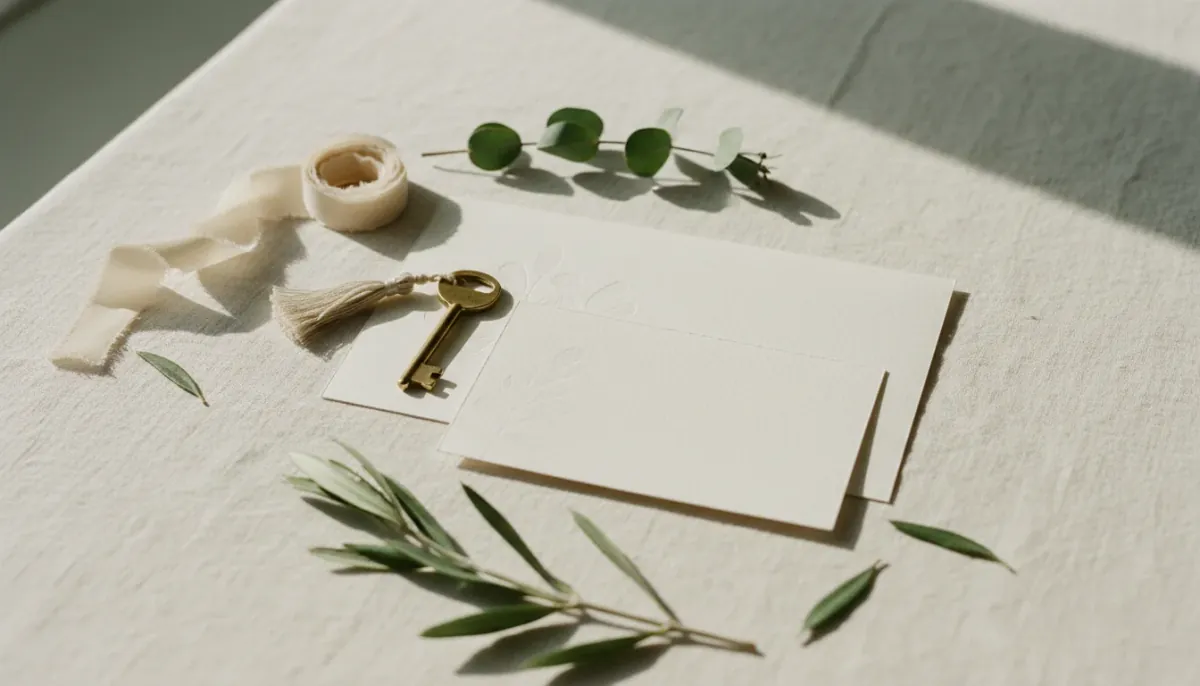
A crowded invitation is hard to read, and a bare one leaves guests texting you about hotels and parking. A wedding details card is the small insert that takes everything except the names, date, time and place off the invitation. On a 4.25 × 5.5 in card it fits in four short sections.
In short, the invitation keeps the names, the date, the time and the ceremony venue. The details card takes the rest: the reception venue if it's somewhere else, the hotel block, your website and the dress code. Four sections are enough for most weddings. Registry information never goes on it.
| Step | Decision | Watch out for |
|---|---|---|
| 1 | Strip the invitation down to who, when and where | Registry links go on the website, never on paper |
| 2 | Choose up to four sections, most useful first | A section nobody needs takes space from one they do |
| 3 | Write each section in two or three short lines | Long text means small type |
| 4 | Decide whether you need the card at all | Two sections or fewer can move to the RSVP card |
| 5 | Print, cut and add it to the envelope | Each extra card adds weight to the envelope |
Step 1: Keep the invitation to who, when and where
An invitation reads best with very little on it. Your names, the hosts, the date, the time and the ceremony venue. Everything a guest needs only later, such as where to sleep or what to wear, can move to the details card.
| Information | Invitation | Details card | Website only |
|---|---|---|---|
| Names, date, time, ceremony venue | Yes | ||
| Reception venue, if different | Short line ("Reception to follow") | Full name and address | |
| Hotel room block and cut-off date | Yes | Also there | |
| Wedding website address | Yes | ||
| Dress code | Optional one word | Yes, with a sentence of guidance | |
| Transport, parking, shuttle times | If short | Full schedule | |
| Registry | Yes | ||
| Weekend schedule, rehearsal dinner | Yes, only for those invited |
The Emily Post Institute's guide to wedding invitations recommends inserts such as maps, directions or hotel information for out-of-town guests. Its registry etiquette is just as clear that registry or gift information goes on neither the invitation nor any of the enclosures. Put it on your website and let family pass it on.
For the lines that stay on the invitation, the guide to wedding invitation wording has examples by host and tone.
Step 2: Choose up to four sections for the wedding details card
Four sections is a good limit for a 4.25 × 5.5 in card. More than that and the type gets small. Rank what you could say by how many guests need it, and keep the top four.
Most weddings rank the four sections like this:
- Reception, if it's at a different venue from the ceremony. Name the place and the town.
- Accommodation, if you have a hotel room block. Name the hotel, the name the block is under and the cut-off date.
- Online, your wedding website address and what guests find there.
- Attire, if your dress code needs a sentence. "Black tie" alone is fine on the invitation. "Garden party, flat shoes for the lawn" belongs here.
Travel or parking can replace one of these when your venue is hard to reach. A note about an adults-only wedding is better handled by how you address the envelope than by a line on a card.
Our wedding details card templates are built around this shape. You type a heading and up to four sections, each with a title and a short text, and watch the card fill in the preview. If you use fewer sections, the card simply holds fewer.
Step 3: Write each section in two or three short lines
Short lines read well at this size. Aim for one or two plain sentences per section. Guests come back to this card when they book a room or pick an outfit, so the fact they need should be easy to spot.
A full details card with two-line sections looks like this.
| Section title | Text |
|---|---|
| Reception | Dinner and dancing follow at The Old Mill, 12 River Road, Hudson. |
| Accommodation | Rooms are held at The Hudson Inn under Lee-Moreno until May 1. |
| Attire | Garden formal. The lawn is soft, so leave the stilettos at home. |
| Online | Directions, the weekend plan and our registry: www.leeandmoreno.wedding |
The website is the right place to point to the registry, because the card itself names no gifts. The Emily Post Institute's wedding website tips suggest sharing your website address on the response card or on an enclosure. The invitation itself stays free of it.
Step 4: Decide when to skip the details card
A details card earns its place when you have at least two things to say beyond the invitation. A separate reception venue and a hotel block are the usual pair. With only one, or none, the card is mostly empty.
Skip the card when your ceremony and reception are at one venue, most guests live nearby, and there is no hotel block or dress code to explain. Put your website address on the RSVP card instead. The guide to wedding RSVP cards shows how to word that line.
Skipping the details card also saves postage. The US Postal Service's letter mailing guide says one Forever stamp covers 1 oz, and each extra ounce costs $0.29 (as of October 2026). Square envelopes cost more too. An invitation, an RSVP card with its envelope and a details card on heavy cardstock can go over 1 oz. Weigh one finished envelope at the post office before you buy stamps.
A details card is also the wrong tool for a full weekend itinerary. Our card holds at most four sections of text, with no map or photo. A weekend of welcome drinks, a rehearsal dinner and a farewell brunch needs your wedding website or a separate itinerary sheet.
Step 5: Print the card and put it in the envelope
A 4.25 × 5.5 in card is a quarter of a US Letter sheet. Print it on the same cardstock as your invitation, between 80 and 110 lb cover (216 to 300 gsm). Set your printer to Actual size (100%), not "Fit to page", and cut on the crop marks with a paper trimmer.
Our details card prints two cards per Letter or A4 sheet, so 100 guests need 50 sheets. If you'd rather use a print shop, the download includes a single-card PDF at the exact size and a JPG at 300 ppi. The guide to printing wedding invitations covers home and shop settings in full.
Stack the cards with the invitation at the back, the details card in front of it and the RSVP card with its envelope on top. Every piece faces the same way, so guests see the names first.
Guests read the invitation once and the details card every time they have a question.
When you're ready, our details card in four designs comes as a download link by email. You open the personalizer from the downloaded folder in Google Chrome on your computer, type your sections, click Download PDF and print. Our invitation suite gives you the invitation, the RSVP card and the details card in one design for $15, or $20 bought separately.
Frequently asked questions
What to include in a details card for a wedding?
The facts guests need that don't fit on the invitation: the reception venue if it differs from the ceremony, the hotel room block and its cut-off date, your wedding website, and the dress code. Leave registry information off and keep it on your website.
Is a details card necessary for wedding invitations?
No. You need one when you have at least two of these to share: a separate reception venue, a hotel block, a dress code that needs explaining, or travel and parking notes. Otherwise a website line on the RSVP card is enough.
What size is a typical wedding details card?
There is no fixed size. A practical one is 4.25 × 5.5 in, a quarter of a US Letter sheet, which sits in front of a 5 × 7 in invitation without hiding it. Our details card uses that size.
Where to print wedding details cards?
At home on cardstock between 80 and 110 lb cover, at Actual size (100%), two cards per sheet, then cut on the crop marks. A print shop also works. Our download includes a single-card PDF and a 300 ppi JPG for shops that take images.
Conclusion
Keep the invitation to who, when and where, and give everything else a home. The details card takes the reception venue if it differs, the hotel block, the website and the dress code, in up to four short sections. Registry links stay on your website. If you have nothing for the second or third section, skip the card and print your website on the RSVP card instead.