Blog
Wedding Invitations on a Budget: What 100 Really Cost
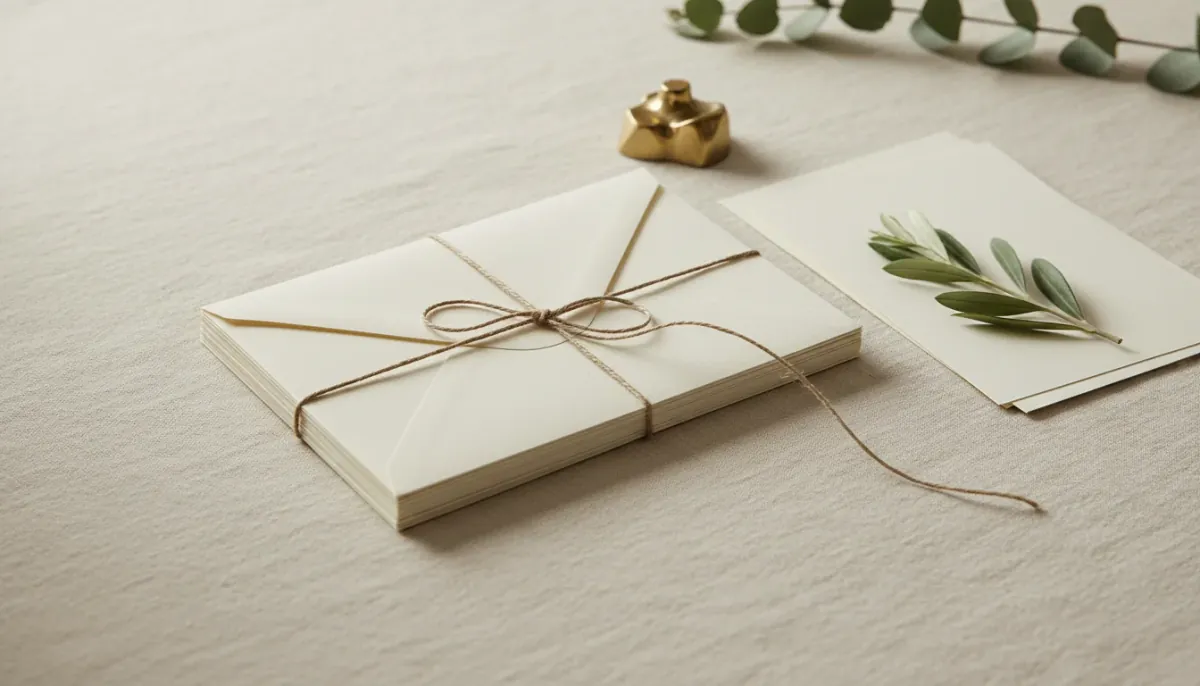
The cards look cheap until stamps, envelopes and ink land on top of them. Wedding invitations on a budget come down to three choices you control: how you print, how many cards go in each envelope, and how you mail them.
Most of what you spend on invitations goes on things that are not the card. Postage, envelopes and the extra cards inside the envelope often cost more than the invitation itself. The sections below compare three routes for 100 invitations and show where each dollar goes, so you can decide what to cut.
Start with the count. You mail one invitation to each address, not one per guest. If most of your 160 guests come as couples, they need about 80 envelopes, not 160. Add five or ten spares for late additions and mistakes.
What 100 invitations cost: ordered set vs template at home vs copy shop
There are three common routes. You order printed invitations from a stationer. You buy a template and print it on your own printer. Or you buy a template and have a copy shop print it. The template routes need one file, whatever the number of guests. An ordered set is priced per card, so every extra address raises the bill.
The table below lists what each route needs for 100 invitation-only envelopes, with the RSVP and details online. Postage is the 2026 USPS price. The other prices are example prices we chose to make the sums visible. Replace them with the prices on your own paper pack, ink cartridge and copy shop quote.
| Cost line | Ordered printed set | Template + home printer | Template + copy shop |
|---|---|---|---|
| Design | in the quote | $8 (one invitation template) | $8 (one invitation template) |
| Cards printed | in the quote | 55 Letter sheets of cardstock, 2 cards per sheet, 5 spare sheets | 55 sheets printed by the shop |
| Paper | in the quote | $16.50 (example: 30 cents a sheet) | in the shop price |
| Printing | in the quote | $27.50 of ink (example: 25 cents per printed side, 110 sides) | $55 (example: $1.00 a sheet) |
| Envelopes | check the quote | $20 (example: 20 cents each) | $20 (example: 20 cents each) |
| Postage, 1 oz letter | $82 (100 × $0.82) | $82 (100 × $0.82) | $82 (100 × $0.82) |
| Total for 100 | your quote + $82 | $154.00 | $165.00 |
The $0.82 stamp is the retail price for a 1-ounce stamped letter in the USPS Notice 123 price list. The same list prices a 2-ounce letter at $1.11. Postage is more than half of the home-printed total in this example. So the cheapest paper changes the result less than how many pieces you mail.
Printed orders win on cost only when the quote is low. With these example prices, home printing costs $72 for 100 before postage. So an order is cheaper only if 100 printed cards with envelopes cost less than $72, which is 72 cents a card. Ask for the total with envelopes and shipping included.
Suite size: full suite vs invitation only
The biggest saving is usually what you leave out of the envelope. A full suite has an invitation, an RSVP card with a stamped reply envelope, and a details card. Each extra card needs paper and ink. The reply card also needs a second envelope and a second stamp.
The full-suite version of the home-printed example uses the 3.5 × 5 in RSVP card, which prints 4 to a Letter sheet, and a 4.25 × 5.5 in details card, which prints 2 to a sheet.
| Cost line | Invitation only, replies online | Full suite with reply envelope |
|---|---|---|
| Templates | $8 | $15 (invitation suite) |
| Cardstock sheets | 55 → $16.50 | 138 → $41.40 |
| Ink | 110 sides → $27.50 | 193 sides → $48.25 |
| Envelopes | 100 → $20 | 200 → $40 |
| Postage out | $82 | $82 |
| Reply stamps | $0 | $82 |
| Total for 100 | $154.00 | $308.65 |
The Emily Post Institute suggests you pre-address and stamp the reply envelope so guests can reply by mail easily. The same advice says replies by email or phone are fine. If most of your guests reply online, a short line on the invitation with your website does the job of the reply card.
Some guests still prefer paper. A middle way is a small batch of printed RSVP cards for older relatives and online replies for everyone else.
Reply postage: stamped reply envelope vs postcard vs online
You have three ways to collect replies, and each has its own price per 100 guests. A reply card in a stamped envelope costs a $0.82 stamp plus the envelope. A reply postcard needs no envelope, and the USPS retail postcard stamp is $0.65. An online reply costs nothing to mail.
| Reply route | Postage for 100 | Envelopes for 100 | Example total |
|---|---|---|---|
| RSVP card + stamped reply envelope | $82 | 100 (example $20) | $102 |
| RSVP postcard | $65 | none | $65 |
| Online reply on your website | $0 | none | $0 |
A postcard must meet the USPS size rules to get the postcard price. The USPS physical standards say a postcard must be at least 3.5 in high, 5 in long and 0.007 in thick, and at most 4.25 in high, 6 in long and 0.016 in thick. A 3.5 × 5 in or a 4.25 × 5.5 in reply card falls inside those sizes. Very heavy cardstock can be thicker than 0.016 in, so measure one card or ask your post office before you print 100.
Postage: square envelope vs standard envelope
A square envelope looks lovely and costs more to mail. The USPS physical standards treat a letter as nonmachinable when its length divided by its height is under 1.3 or over 2.5. A square envelope has a ratio of 1. Notice 123 adds a $0.49 nonmachinable surcharge to each one.
For 100 square invitations, the surcharge adds $49 on top of the stamps. A standard rectangular envelope for a 5 × 7 in card avoids it. Wax seals, ribbons and other closures can also make an envelope nonmachinable, because the standards list clasps, strings and buttons and items that make the thickness uneven.
Weight adds up faster than people expect. A 5 × 7 in card on 300 gsm (110 lb cover) cardstock weighs about 6.8 grams, from its area times the paper weight. A 3.5 × 5 in RSVP card and a 4.25 × 5.5 in details card on the same paper bring the three cards to about 14.7 grams. If each envelope weighs around 5 grams, an assumption you can check on your scale, the full suite lands near 25 grams. That is under 1 ounce, but not by much. Add a vellum wrap or a second insert and you may cross it.
The stamp often costs more than the card it carries.
Time and effort: home printer vs copy shop
Home printing is the cheapest route in our example, but it takes your time. You print 55 sheets for 100 invitations, both sides, then cut 110 cards. A paper trimmer makes straight cuts quicker than scissors. Plan an evening for printing and another for cutting and stuffing.
A copy shop saves the printing time and costs more per sheet. It also helps when your printer struggles with thick cardstock or prints colors dull. The shop can print from a PDF on Letter sheets or from a single card image. For the settings that keep the size right, see how to print wedding invitations. If you are designing the cards yourself from scratch, the steps are in DIY wedding invitations.
The trade-off between your time and the shop's price is simple to work out. In our example the copy shop route costs $11 more for 100 invitation-only envelopes. If an evening of printing is worth more than that to you, the copy shop is the better deal.
Design cost: free template vs paid template vs ordered design
Free templates exist, and a free one can work for one card. The cost shows up when you need a matching RSVP card, details card and later the signs, and the free designs do not match. A paid template is a one-time cost, whatever the guest count. An ordered design is usually paid for inside the per-card price.
Our wedding invitation templates cost $8 for the invitation or $15 for the invitation suite with the RSVP card and details card ($20 if bought separately). After paying, you get a download link by email. In the folder is a personalizer, a page you open in Google Chrome on a computer, straight from the downloaded folder. It works offline and nothing is uploaded. You type your names, date and wording, watch the preview, click Download PDF and print. It also saves a JPG at 300 ppi for print shops, and it offers six color palettes and two layouts per card.
A template is the wrong choice in some cases. With only a phone or tablet, the personalizer will not work for you, because it needs Chrome on a computer. For letterpress, foil, photos or printed envelope addressing, you need a stationer or print shop. And if you hate cutting cards, an ordered set or a copy shop with a cutting service saves you that job.
Wedding invitations on a budget: the three routes side by side
| What you weigh | Ordered printed set | Template + home printer | Template + copy shop |
|---|---|---|---|
| Cost for 100 (example, invitation only) | your quote + $82 postage | $154.00 | $165.00 |
| Cost grows with each extra guest | yes, per card | paper, ink, envelope, stamp | sheet price, envelope, stamp |
| Your time | ordering and proofing | printing and cutting | dropping off and cutting |
| Print finish | the stationer's | as good as your printer | the shop's printer and card |
| Matching RSVP and details cards | usually extra per card | in the same suite file | in the same suite file |
| Best for | foil, letterpress, photos | the lowest total | thick card, faster turnaround |
For the lowest total, print the invitation at home, mail it in a rectangular envelope and take replies online. If you want the cards printed for you but still want to save, ask for quotes and compare them with the break-even price of your own home print. When you are ready to set your wording, open the invitation templates for the invitation and suite and check the sizes against your envelopes before you print.
Frequently asked questions
How to do wedding invites on a budget?
Mail one invitation per household in a standard rectangular envelope, put the details on a wedding website, collect replies online or by postcard, and print the cards yourself from a template on cardstock. In our worked example that brings 100 invitations to about $154 including stamps, against about $309 for a full suite with a stamped reply envelope.
What's the cheapest way to do wedding invitations?
A single invitation card printed at home, mailed at the 1-ounce letter rate of $0.82 in a rectangular envelope, with replies collected online. Postage is then the largest cost, so the cheapest paper choice changes the total less than leaving out the reply envelope and the extra cards.
How much should 50 wedding invitations cost?
With the same example prices as this article (30 cents a sheet of cardstock, 25 cents of ink per printed side, 20 cents an envelope) and an $8 template, 50 invitation-only envelopes come to about $81.40, of which $41 is postage at $0.82 a stamp.
Conclusion
Count addresses, not guests, then price each route for that number with your own paper and print quotes. Keep the invitation on paper, move the details and the replies online if your guests are comfortable with that, use a standard rectangular envelope, and weigh one finished envelope before you buy stamps. Those four steps decide most of what 100 invitations cost, whichever design or printer you choose.